
James B. Jacobs
Breaking the Devil’s Pact
Because the book presents an historical case study of U.S. v. IBT, it would best be approached chronologically.
The Timeline (pages xix—xxi in the book) is a thumbnail overview of the most important events in the 22+ years of the life of the lawsuit.
But the Timeline does not give any sense of the analysis which the book provides.
Chapter 1, “Introducing the Litigants and the Judge,” is about the many “big personalities” who have been involved with this case, including Rudy Giuliani for the U.S. Department of Justice and the original IBT and LCN defendants, as well as the rank and file interveners, and David Edelstein, the brilliant and irascible federal judge.
Perhaps Chapter 7 is the book’s most dramatic and compelling chapter. It recounts the fall of Ron Carey, the insurgent “reformer” whose 1991 election was heralded as proof of the success of the U.S. v. IBT election reform remedial prong. The court-appointed officers charged Carey’s 1996 election campaign with embezzling union money for Carey’s re-election. Carey’s 1996 victory was voided and he was expelled from the union.
Breaking the Devil’s Pact corrects the “fairy tale” history of the labor movement.
Organized crime figures started penetrating labor unions in the early 20th century. Some early labor leaders, like David Dubinsky, strongly opposed gangsterism in the labor movement. In 1957, the AFL-CIO expelled the Teamsters on account of corruption and racketeering. Eventually, however, opposition (except for a small number of so-called union “dissidents”) all but disappeared until the Department of Justice (DOJ) became involved in the early 1980s. DOJ’s involvement was precipitated by its goal of eradicating LCN—not by a goal of cleaning up unions.
Breaking the Devil’s Pact contributes to our understanding of union democracy.
Teamsters For a Democratic Union (TDU), the best-organized and largest “dissident organization” in the union movement supported the government’s civil RICO lawsuit against the IBT establishment, but strenuously argued in favor of a union democracy remedy.TDU insisted that if the government could ensure free and fair elections, the rank and file would replace gangsters and their cronies with honest and effective union officers.
This is an important hypothesis. Indeed, the same hypothesis appears in foreign policy debates—will free and fair elections bring honest and effective political leaders to power?
Unfortunately, the answer for both unions and nation states is “not always.” Free and fair elections may be a necessary, but not sufficient, condition for good government.
Breaking the Devil’s Pact sheds light on American politics.
On the one hand, there could hardly be a more cynical commentary on American politicians than that, in 1988, almost 300 Congressmen would petition the U.S. attorney general not to bring the rumored civil RICO lawsuit against the IBT on the ground that it would be a blow to a “free and democratic labor movement.”
On the other hand, that five U.S. presidential administrations, both Republican and Democrat, have permitted the lawsuit to continue evidences and reinforces the independence of the U.S. Department of Justice and the supremacy of the rule of law in the United States.
Editor: Erind Pajo
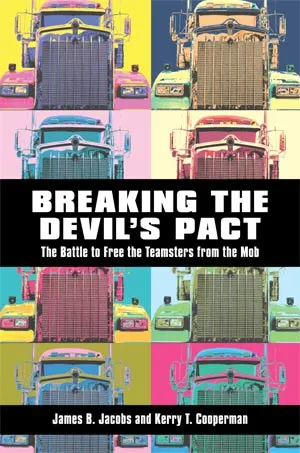
Breaking the Devil’s Pact
James B. Jacobs and Kerry T. Cooperman Breaking the Devil’s Pact: The Battle to Free the Teamsters From the Mob New York University Press 320 pages, 6 1/2 x 9 1/2 inches ISBN 978 0814743089
Available here →October 31, 2011
20111031-jacobs-james-on-breaking-devil-pact-battle-free-teamster-mob-3
A close-up
The rest of this thread

James B. Jacobs
James B. Jacobs is the Warren E. Burger Professor of Law at NYU School of Law, where he has been a faculty member, specializing in criminal law and criminal procedure, since 1982. Breaking the Devil’s Pact, co-authored with Kerry T. Cooperman, and featured on Rorotoko, is his fifth book on the U.S. government’s long-term campaign against Italian-American organized crime, la Cosa Nostra.
Pull this thread
The civil RICO intervention in the Teamsters worked, and government intervention for union democracy makes a stronger union.
Know something the rest of us don't?
Most threads on Rorotoko begin with our invitation. Any thread can begin with a proposal: you write it with the same prompts every thread answers, and we review it.
Propose a thread →