
Leslie Paul Thiele
Indra's Net and the Midas Touch
After much delay, there is in my own country widespread acknowledgement that global warming is real and human-caused. That is a welcome development. Still, to admit that we have engineered the greatest change to the atmosphere, and potentially to the biosphere, that the earth has seen in the last half million years, is to obscure a still more potent truth.To be sure, humankind is a powerful force on this planet. As a species, we are game changers. But the more important acknowledgement is that our potentially irreversible alteration of natural cycles and planetary conditions has been an unintended consequence. Like overpopulation, pollution, and the loss of biodiversity, climate change is a side effect. It is the unforeseen result of our consumption of fossil fuels and forests. The most menacing and pressing problems that we face today, the things that undermine prospects for our progeny, are by-products.
Climate change presents an unparalleled crisis. It is difficult to overstate the magnitude of the problem—and likewise, the opportunity—it presents. Still, the more daunting challenge is to come to grips with a simple truth: we can never do merely one thing. And it is the things that we unintentionally do that now come back to haunt us with a vengeance.In this light, to confront climate change, or any other environmental issue, as a problem to be bested by human ingenuity is to commit a fateful error.I don’t want to be misunderstood here. We need to combat climate change—as well as pollution, species extinction, resource depletion, and overpopulation—with greater urgency. And technology can and should be a powerful ally. But the only sustainable means of addressing such dire concerns, for net-dwellers like us, is through a fundamental transformation of what it means to solve problems.
Today we find ourselves grappling with the unintended consequences of actions that were once proffered as answers. That is to say, most of our current problems are the legacy of former solutions. Typically, they were solutions to some specific problem that was itself the unintended consequence of an earlier solution. As the myth of Midas testifies, the human race has been playing at this game for thousands of years. The legendary King Midas had his wish granted that everything he touched be transformed into gold. But gaining unsurpassed riches had the unintended consequence of threatening his life, as every morsel of food touching his lips became petrified into indigestible metal.Ironically, the story of Midas has itself received the Midas touch. It was meant as a forewarning of the unintended consequences of self-serving and shortsighted choices. But today when we attribute the Midas touch to an individual—typically in business affairs—we mean that this person has a knack for transforming opportunities into enduring economic success. Effectively, we have gilded the myth of Midas, conveniently ignoring its profound and disturbing moral. Readers should not assume that Indra’s Net and the Midas Touch is an unhopeful book.
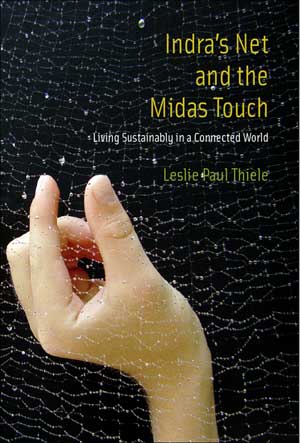
The Midas myth urges caution and prudence, to be sure. But the myth of Indra’s net suggests why our interdependencies are full of promise.Indra is the king of the Vedic deities. Over his palace, it was said, hangs a net that stretches in all directions to infinity. At each node of the net, where the gossamer strands intersect, hangs a beautiful jewel. And each facet of every jewel provides a reflection of all the other jewels. The ancient sages insisted that the jewels hanging from Indra’s net are not enduring substances. They do not have an essential nature. Rather, each jewel is the manifestation of relationships of interdependence. Each jewel exists only as the cavalcade of reflections to which it contributes.All the strands of Indra’s net are connected. Sever one, and the whole is weakened.
This is the upshot of interdependence. But the jewels on Indra’s net also mirror each other. They are, in the end, nothing but the aggregation of such reflections. Relationship, not an individual essence, is their core reality. My book is meant to illustrate how a growing awareness of our interdependence, understood as the core of our being, is the only viable means of sustaining ourselves and our world. I develop the notion of ecosophic awareness to denote a mindful attention to relations of interdependence and a hopeful investment in them.
Ecosophic awareness in a connected, changing world fosters adaptation. Sustainability, in the end, is not about the human race becoming the curator of a planetary museum. It is about our learning how to manage the rate and scale of change within economic, social, and ecological systems so as to maintain their core values and relationships. To be advocates of sustainability, we have to become midwives of the future.
Editor: Erind Pajo
Indra's Net and the Midas Touch
Leslie Paul Thiele Indra's Net and the Midas Touch: Living Sustainably in a Connected World The MIT Press344 pages, 6 x 9 inches ISBN 978 0262016094
Available here →November 23, 2011
20111123-thiele-leslie-on-indras-net-midas-touch-3
A close-up
The rest of this thread

Leslie Paul Thiele
Leslie Paul Thiele teaches political theory and serves as Director of Sustainability Studies at the University of Florida. His interdisciplinary research focuses on sustainability issues and the intersection of political philosophy and the natural sciences. His central concerns are the responsibilities of citizenship and the opportunities for leadership in a world of rapid technological, social, and ecological change. Besides Indra’s Net and the Midas Touch, featured on Rorotoko, his recent books include The Heart of Judgment: Practical Wisdom, Narrative, and Neuroscience (Cambridge 2006) and Working Toward Sustainability: Ethical Decision Making in a Technological World (co-authored, Wiley, 2011). Dr. Thiele is currently developing practical principles inspired by nature to guide individual lifestyles and organizational practices. The work is tentatively entitled “Nature’s Compass.”
Pull this thread
Climate change is a by-product we did not intend, so attacking it with more ingenuity is a fateful error.
Know something the rest of us don't?
Most threads on Rorotoko begin with our invitation. Any thread can begin with a proposal: you write it with the same prompts every thread answers, and we review it.
Propose a thread →