
Leslie Paul Thiele
Indra's Net and the Midas Touch
Sustainability is all the rage these days. It is espoused by government agencies from the local to the national, by international bodies, and by proliferating citizens’ groups and non-governmental organizations. It is being incorporated into existing academic programs and defines wholly new ones (like the one I direct). And it shapes business practices, from the community affairs of local grocers to the mission statements of Fortune 500 companies. Sustainability is widely championed today as a core value. At times bona fide commitment, at times greenwashing PR or a curtsey to trendiness, sustainability is very much in the news, in advertising, in our homes and offices, and on the streets.
For two decades now, sustainability has been defined as the effort to meet social, environmental, and economic needs without undermining the capacity of future generations to meet their own needs. It addresses the question of how we can pursue the good life without this pursuit burdening progeny with debt and devastation. Living as we do in nations drowning in debt under skies thickening with greenhouse gases, the prospects for future generations appear rather glum. If sustainability is just the flavor of the day, we can be guaranteed, given the breadth and depth of the crises we face and the relatively meager efforts to address them thus far, that it is going to be a very, very long day.
For all the time and effort spent addressing why we are in such dire straits, there has been little in the way of reflection on the sort of world that makes sustainability a compelling value, and likely a central value for the foreseeable future. I argue that there are two fundamental reasons why we live at a time where the pursuit of sustainability is fast becoming the core commitment of government, civil society, householders, and business, and, at the same time, remains a Sisyphean task. First, our lives are increasingly defined by relationships of interdependence. Never before have so many individuals, organizations, and fields of activity been so complexly connected. Second, and as a consequence of these expanding and deepening webs, the “law of unintended consequences” has gained an unprecedented jurisdiction. Today, it reigns across the scope of our lives, and presents the gravest of threats.
Some readers might appreciate the book as a primer in sustainability theory and practice. I mean it to be more than that. My effort has been to illustrate how interdependence has become the most salient feature of our lives, and how unintended consequences, in such a world, both threaten civilization and offer great promise.
Editor: Erind Pajo
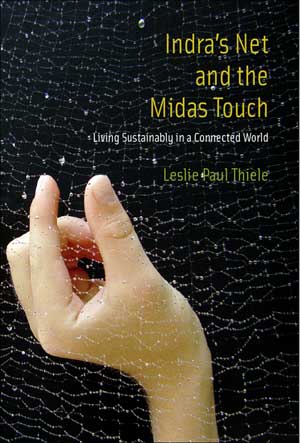
Indra's Net and the Midas Touch
Leslie Paul Thiele Indra's Net and the Midas Touch: Living Sustainably in a Connected World The MIT Press 344 pages, 6 x 9 inches ISBN 978 0262016094
Available here →November 23, 2011
20111123-thiele-leslie-on-indras-net-midas-touch-1
In a nutshell
The rest of this thread

Leslie Paul Thiele
Leslie Paul Thiele teaches political theory and serves as Director of Sustainability Studies at the University of Florida. His interdisciplinary research focuses on sustainability issues and the intersection of political philosophy and the natural sciences. His central concerns are the responsibilities of citizenship and the opportunities for leadership in a world of rapid technological, social, and ecological change. Besides Indra’s Net and the Midas Touch, featured on Rorotoko, his recent books include The Heart of Judgment: Practical Wisdom, Narrative, and Neuroscience (Cambridge 2006) and Working Toward Sustainability: Ethical Decision Making in a Technological World (co-authored, Wiley, 2011). Dr. Thiele is currently developing practical principles inspired by nature to guide individual lifestyles and organizational practices. The work is tentatively entitled “Nature’s Compass.”
Pull this thread
The gravest environmental threats are unintended by-products, not problems to be beaten by ingenuity.
Know something the rest of us don't?
Most threads on Rorotoko begin with our invitation. Any thread can begin with a proposal: you write it with the same prompts every thread answers, and we review it.
Propose a thread →