
Jane Chi Hyun Park
Yellow Future
I started writing this book in a period when the political position of Asian Americans seemed to be oscillating between appearing either as threats to middle America or tokens of multicultural solidarity, often lending legitimacy to myths about social meritocracy and jarring somewhat with my own experiences. It struck me that the conditional visibility of Asian American scholarship, lobby groups, and activism, as well as celebrities, popular food chains, fashion, and so on, paralleled the awkward presence of Asian themes and imagery in Hollywood movies – that is, how symbols of Asia generally occupy the background, appearing occasionally as breathtaking spectacles or helpful secondary players, only to wander back to the wings, so to speak.
Flicking from current affairs programs to re-runs, I wondered whether the now familiar promise of exchange with different cultural perspectives might contain its own foreclosures and refusals, and lead to an active willing away of substantive Asian and Asian diasporic experiences through a kind of overzealous aestheticism.
At the same time, I couldn’t simply dismiss the new, “cool” images of East Asia and Asian America that were emerging in the late 1990s, from Giant Robot to The Iron Chef to the ubiquitous figures of Margaret Cho and Lucy Liu because of my own ambivalent relationship to them. On the one hand, they were products I sometimes enjoyed consuming; on the other, they seemed to limit how I could position myself as well as how others would position me vis-à-vis pop culture and the banal landscape of the everyday.
Since then, East Asian bodies, cultures, and styles have become ever more visible in US entertainment media, evidenced by the growing number of Asian faces in such television shows as Lost, Heroes, and Gray’s Anatomy; the popularity of the Korean Wave or Hallyu; and the disturbing proliferation of supposedly ironic yellowface in music videos, video games, and the Internet. My book offers an interdisciplinary approach for making sense of these racialized images as complex cultural productions – one that tries to go beyond condemning such images for disseminating “negative stereotypes” or celebrating them simply for existing.
To be honest, though most of these anxieties come as a kind of aftershock. The book really stemmed from my love for most of these films, with the stories that can be read in and out of the central narratives. I’ve tried hard in Yellow Future to maintain a balance between the pleasures these stories have to offer and their often hilarious, and always instructive, moments of failure.
Editor: Erind Pajo
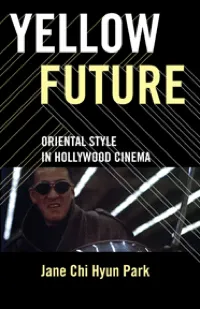
Yellow Future
Jane Chi Hyun Park Yellow Future: Oriental Style in Hollywood Cinema University of Minnesota Press 304 pages, 5 1/2 x 8 1/4 inches ISBN 978 0816649792 hb ISBN 978 0816649808 pb
Available here →November 30, 2011
20111130-park-jane-on-yellow-future-oriental-style-hollywood-cinema-2
The wide angle
The rest of this thread

Jane Chi Hyun Park
Jane Chi Hyun Park is a lecturer in the Department of Gender and Cultural Studies and the United States Studies Centre at the University of Sydney. Her research focuses on race, gender, and popular media in the United States and the Asia Pacific. She has published essays on a variety of topics, including mixed-race Hollywood actors, Japanese-American hip-hop, and Korean romantic comedies. Dr. Park is currently working on two projects, one on rethinking diaspora in the Asia Pacific through popular culture, and another on transnational flows of contemporary South Korean food, beauty and media.
Pull this thread
pulls againstpulls alongside
Hollywood's oriental style structures films that appear to have nothing to do with Asia or race at all.
Against PG · Cocaine was a legal Andean export until the 1940s, and US Cold War politics made it a criminal trade. On: Cultural and technical influence in imperial encounters ran outward from metropole to periphery
Against EG · Ancient Mediterranean peoples built their identities more by claiming kinship with foreigners than by disparaging them. On: Groups constitute their identity chiefly by defining themselves against an excluded Other
Against GS · Islamic science grew from the needs of a new empire and competition among displaced bureaucratic families. On: Cultural and technical influence in imperial encounters ran outward from metropole to periphery
Against MR · A nineteenth-century Istanbul artwork's meaning belongs to the circuit it moved through, not to its maker. On: Groups constitute their identity chiefly by defining themselves against an excluded Other
Alongside JP · All opera is postcolonial, but opera cannot be decolonial. On: Cultural and technical influence in imperial encounters ran outward from metropole to periphery
Alongside IA · German thinkers from Leibniz to Nietzsche knew far more about their Ottoman neighbours than their published work admits. On: Groups constitute their identity chiefly by defining themselves against an excluded Other
Alongside LM · UNESCO's heritage work was forged by the colonizing powers as the last gasp of the civilizing mission. On: Cultural and technical influence in imperial encounters ran outward from metropole to periphery
Alongside DS · Dehumanization works because its victims are seen as human vermin, uncanny fusions of fellow human and subhuman creature. On: Groups constitute their identity chiefly by defining themselves against an excluded Other
Know something the rest of us don't?
Most threads on Rorotoko begin with our invitation. Any thread can begin with a proposal: you write it with the same prompts every thread answers, and we review it.
Propose a thread →