
Jane Chi Hyun Park
Yellow Future
My favorite pages in the book are pages 58 to 64, the subheading titled “Imaging the Future” in which I describe how Ridley Scott, the director of Blade Runner and his production crew imagined and created the futuristic world of the film. Along with watching this film more times than I’d care to admit, I also read Do Androids Dream of Electric Sheep, the proto-cyberpunk novel by Philip K. Dick from which it was adapted. I remember scouring the book for the non-western references that constitute the apocalyptic Los Angeles of 2019 in the movie: Tyrell’s mega-corporation, which resembles an ancient Mayan temple; the night markets teeming with Asian and Middle Eastern hawkers selling food and exotic animals; the neon Chinese and Japanese script; the constantly flashing billboard of a geisha (played, incidentally, by a Korean-American actress); and the secondary East Asian characters, small-time entrepreneurs, that help lead the refugee replicants to their negligent and uncaring corporate father.
Imagine my surprise at not finding any of these references in the novel, which is set almost entirely indoors and whose only nod to ethnicity is “Rosen,” the presumably Jewish name of the corporation that manufactures the replicants.
This made me even more interested to track down how the “Orient” came to play such a prominent role in the mise-en-scène of the film. What I uncovered in nerdy paraphernalia around Blade Runner, including interviews published in cinematography journals, was the story of a group of highly creative, cosmopolitan Anglo-British and American men who were able to conjure a future gone wrong drawing on their fantasies of the East.
Predictably, Asia functions in Blade Runner as the alluring and foreign “other” of the West, the normal, and the present: it is the extra kick that makes the near future look like “New York on a bad day” to quote the director – dirty, overcrowded, full of freaks, the poor, and people of color. Yet not so predictably, this “other” also is linked with the morally ambiguous hero (and yes, Deckard is a replicant).
What I wanted to show in the rest of the chapter through my analysis of oriental style in the film’s architecture, cityscape, and characters is how what some of us might be quick to identify as racist isn’t always intentional – that in fact, such unintentional, casual racism continues the imperialist legacy of seeing non-white people as “not quite human.” At the same time, the fascination with Asia evidenced in the creation of the set, complicates a straightforward critique of Orientalism or racism, and begs the question of how we might envision the future differently through non-white and non-western perspectives.
These perspectives have been and continue to be discussed among scholars working on Afrofuturism and techno-orientalism – material that I wish I had been able to engage with more deeply in the book. There is also some excellent work being done at the moment on transnational connections between the US and East Asia, especially in terms of Afro-Orientalism and Pacific Rim diasporas, so if nothing else, it would be great if Yellow Future could play a role in connecting research in these areas of ethnic cultural studies with film scholarship, which itself is overhauling older paradigms through renewed emphasis on production cultures, local media ecologies, and so on.
My ideal would also be for “oriental style” to travel a little further than I’ve had space in Yellow Future. There are all kinds of things happening right now in advertising, cultural tourism, and corporate branding that dovetail with what this book is trying to get at – the way that “Asia” comes to frame all kinds of popular reflections on the present, on modernity, on the future – for better or worse.
So while I’ve been writing within my home disciplines of Asian American studies and film studies, I would be happy if some of my ideas strike a chord in some less familiar places, including outside the academy. I have to admit that I feel the most gratified when one of my serious film buff friends tells me they got really excited about something I put in my book. And meanwhile, I try not to be too mortified when they remind me of all the things that I managed to leave out.
Editor: Erind Pajo
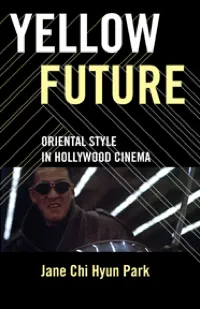
Yellow Future
Jane Chi Hyun Park Yellow Future: Oriental Style in Hollywood Cinema University of Minnesota Press304 pages, 5 1/2 x 8 1/4 inches ISBN 978 0816649792 hb ISBN 978 0816649808 pb
Available here →November 30, 2011
20111130-park-jane-on-yellow-future-oriental-style-hollywood-cinema-3
A close-up
The rest of this thread

Jane Chi Hyun Park
Jane Chi Hyun Park is a lecturer in the Department of Gender and Cultural Studies and the United States Studies Centre at the University of Sydney. Her research focuses on race, gender, and popular media in the United States and the Asia Pacific. She has published essays on a variety of topics, including mixed-race Hollywood actors, Japanese-American hip-hop, and Korean romantic comedies. Dr. Park is currently working on two projects, one on rethinking diaspora in the Asia Pacific through popular culture, and another on transnational flows of contemporary South Korean food, beauty and media.
Pull this thread
Hollywood's oriental style structures films that appear to have nothing to do with Asia or race at all.
Know something the rest of us don't?
Most threads on Rorotoko begin with our invitation. Any thread can begin with a proposal: you write it with the same prompts every thread answers, and we review it.
Propose a thread →