
Markus Krajewski
Paper Machines
Paper Machines outlines the story of the card index in manifold ways: as a library catalogue, as a collection for thinkers, and as a tool for office efficiency. And yet it outlines a whole genealogy from its primordial scene in 1548, when a Zurich based polymath named Conrad Gesner starts thinking about cutting information into pieces, up to 1929, the beginning of the electrical era in the office and the new age of data processing.
This book deals with the history of a crucial cultural technique which has been neglected so far, though it operates on the very basis of our intellectual life: freely moving around pieces of data on paper slips is one way to cope with the notorious information overflow. Before the dawn of the computer age information was usually stored on paper, often kept in notebooks for further use. I argue that the card index is the obvious precursor of the computer as a data processing device.
Paper Machines unfolds the history of cutting those papers of thinking in pieces instead of keeping them in bound form, and how those mobile elements provide a specific advantage not only for data processing purposes or for library use. Furthermore paper slips serve as very basic as well as productive tools of thinking for both, more efficient handling and—what is more—for scholarly purposes.
The main thesis focuses on the often hidden, unmentioned learned practices which paper slips or index cards provide as a fundamental device for thinking. Paper Machines argues, beyond the long history of the book, in favor of an alternative genealogy of data processing and information flow which is—despite its elements—deeply rooted in our cultural technology.
The narrative makes a strong contribution to a new historiographical approach, i.e. developing an argumentation in an entertaining as well as theoretically challenging manner. That's the way how media theory could be fun.
The nucleus for writing the history of the card index was set after I’d for some time been developing Synapsen, a software that serves as my personal hypertextual card index. While working on the code I wondered about the longer history of this very tool as a thinking device. And so, I started reading and researching. First I read the sources which were already fed into my “Synapsen,” then I visited different archives and excerpted more material which gradually flooded my narrative.
But thanks to my software the line of argumentation could be saved from drowning—it could be even enriched and streamlined at the same time, due to my electronic card index which tended to write its own history almost without further help.
Editor: Erind Pajo
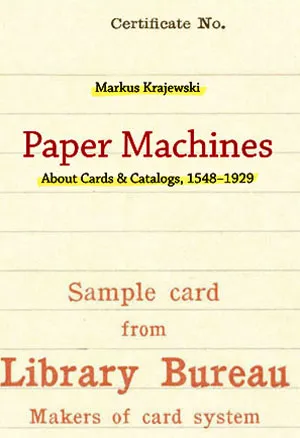
Paper Machines
Markus Krajewski Paper Machines: About Cards & Catalogs, 1548-1929 Translated by Peter Krapp The MIT Press 224 pages, 6 x 9 inches ISBN 978 0262015899
Available here →January 30, 2012
20120130-krajewski-markus-on-paper-machines-2-1
The wide angle
The rest of this thread

Markus Krajewski
Markus Krajewski is Associate Professor of Media History of Science at Bauhaus University Weimar, and has been a fellow at the Humanities Center at Harvard University. Besides Paper Machines, featured on Rorotoko, he is the author of Der Diener. Mediengeschichte einer Figur zwischen König und Klient, forthcoming in English as “The Servant: Media History of a Figure between King and Client,” and Restlosigkeit: Weltprojekte um 1900. His current research projects include the history of exactitude or the epistemology of the peripheral. Markus Krajewski is also the developer of Synapsen—a hypertextual card index.
Pull this thread
pulls againstpulls alongside
The card index, not the book, is the direct precursor of the computer.
Against MB · Modern advertising differs in kind from everything before it, and for the first time it meets no legal resistance. On: The present technological moment is unprecedented rather than a repetition of earlier ones
Against GB · Early American cinema's handling of race ran on the Picturesque, inherited from painting, prints and photography. On: Technology causes the social changes attributed to it
Against RH · Humans are themselves a technology, and that technology is analog, so digital does not reflect what we are. On: The present technological moment is unprecedented rather than a repetition of earlier ones
Against MK · The automaton fascinates because an artificial thing that acts alive breaches the living/dead binary, so delight and horror arrive together. On: Technology causes the social changes attributed to it
Alongside AM · The idea of robots is ancient, and Hesiod's Talos, with inner workings and a power source, qualifies as one. On: The present technological moment is unprecedented rather than a repetition of earlier ones
Alongside ED · Speed is modernity's one genuinely new pleasure, and modernist art responds to its thrill, not to alienation. On: Technology causes the social changes attributed to it
Alongside DC · Addiction proliferated because entrepreneurs welded vices into limbic capitalism, a global system that systematically undermines appetite control. On: The present technological moment is unprecedented rather than a repetition of earlier ones
Alongside IH · Humans head toward ever more stuff because when things fail the fix is more things, and that cannot be reversed. On: Technology causes the social changes attributed to it
Know something the rest of us don't?
Most threads on Rorotoko begin with our invitation. Any thread can begin with a proposal: you write it with the same prompts every thread answers, and we review it.
Propose a thread →