
Albena Azmanova
The Scandal of Reason
This book defends the duty of judgment and the freedom to err. Against the modernist ambition to discover truth by the power of reason, and post-modernist flagellation of both truth and reason, it urges that we drop the crutches of ideal theory when we think about justice and act upon injustice. The book offers a model of a pragmatic assessment of the grounds and direction of political action aiming singularly at the alleviation of existing human suffering.
The project is driven by the search for a politically useful theory of justice.
Much needed policy action is either blocked or sidetracked by hefty pondering about the grounds, goals, and preconditions for policy action. Did we get Iraq wrong? Should we intervene to stop the carnage in Syria? Should the wearing of the Islamic headscarf be allowed in public office in our secular republics? Should failing banks be bailed out by taxpayers? Should the European Union impose austerity measures on the Greeks as it is saving the Greek state from bankruptcy?
While politicians, when facing hard cases, are often in need of intellectual guidance, political philosophers have hardly ever offered ideas that can help or serve a politician—as the German philosopher Karl-Otto Apel once noted in exasperation. Indeed, for centuries learned men and women have supplied elaborate theories spelling out conflicting rights and duties and unattainable conditions for their satisfaction.
That political judgment is cursed by a perpetual wandering between vision and practicality, between high moral ideals and the pragmatics of political life, is something Aristotle already warned about. Aristotle observed that even though justice might be essential for political life, a science of politics and therefore a scientific theory of justice is unattainable. In matters political, he claimed, the particulars of our collective existence are the proper object of judgment. Therefore, practical wisdom, not general principles and theoretical reasoning, is what is needed when we judge the right organization of society.
Ironically, the design of a theory of justice seems to be as impossible as justice is essential for politics. The book offers a way out of this conundrum by replacing the search for high-minded theory of justice with a model of practical judgment.
Editor: Erind Pajo
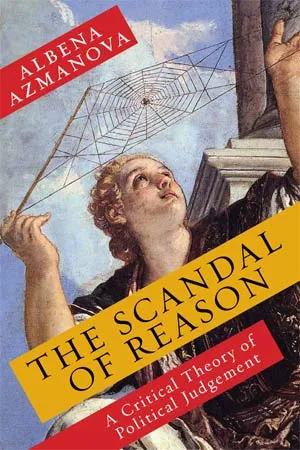
The Scandal of Reason
Albena Azmanova The Scandal of Reason: A Critical Theory of Political Judgment Columbia University Press 296 pages, 6 x 9 inches ISBN 978 0231153805
Available here →March 28, 2012
20120328-azmanova-albena-on-the-scandal-of-reason-1-1-1
In a nutshell
The rest of this thread

Albena Azmanova
Albena Azmanova teaches political and social theory at the University of Kent’s Brussels School of International Studies, where she directs the graduate programs “International Political Economy” and “Political Strategy and Communication.” After having taken active participation in the dissident movements and student strikes that brought down the communist regime in her native Bulgaria in 1987-1990, she studied European Law at Strasbourg University, did her doctoral studies at the New School for Social Research in New York, and taught political theory at the Institut d’Etudes Politics (Sciences Po.) in Paris. Her writing focuses on democratic transition and consolidation, European integration, social justice, and the contemporary transformation of political ideologies.
Pull this thread
Ideal theories of justice should be dropped entirely, and judgment should start from the physical sensation of injustice.
Know something the rest of us don't?
Most threads on Rorotoko begin with our invitation. Any thread can begin with a proposal: you write it with the same prompts every thread answers, and we review it.
Propose a thread →