
Albena Azmanova
The Scandal of Reason
Although the Enlightenment, at the dawn of Modernity, raised the beacon of Reason and thus raised humanity’s hopes for a right answer to complex issues, doubts about that promise emerged early on. One of the most prominent advocates of reason, Immanuel Kant, was exasperated by what he called “the Scandal of Reason.” The “scandal” is this: as much as the human mind is incapable of certain and verifiable knowledge, we are invariably compelled to seek such knowledge, especially concerning matters of human existence.
The controversial faculty of reasoned judgment to waver between the extremes of uncertainty and dogma, of doubt and treacherous certainty, and to both destabilize political rules and render justification to morally appalling political rule (like Nazism and Stalinism), is the political expression of the “scandal of reason.”
From the scandal of reason grows what I call the “paradox of judgment”—the more ambitious the ideal of justice, the less applicable and useful the model is to political practice; yet the more politically realistic the theory, the weaker is its moral ambition, rendering the model unsound and equally useless.
So how do we know what is the right course of action and even when to act and when to stay put?
Rejecting, in a post-modern posture, the fundamentalist Enlightenment view of human beings as rational autonomous individuals is no answer. Because in this way we escape the guilt of embarking on an erroneous course of action only by succumbing to the guilt of becoming complicit to evil by not opposing it. As Hanna Arendt observed, when we are not guilty of “crimes of commission” we are guilty of “crimes of omission.”
This means that whether we want it or not, we cannot suspend political judgment: we are equally responsible when we act as when we abstain from acting.
In order to resolve the paradox of judgment and offer a politically useful theory of justice, I propose to set aside ideal theory and instead focus on specific human suffering and the possibility to attenuate it. Thus, I develop a model that invites to look at injustice from the point of view of those who are subjected to injustice and pay attention to the way people formulate, and make sense, of their grievances.
The question “What is Justice?” gives way to the question “Who suffers and why?”
Editor: Erind Pajo
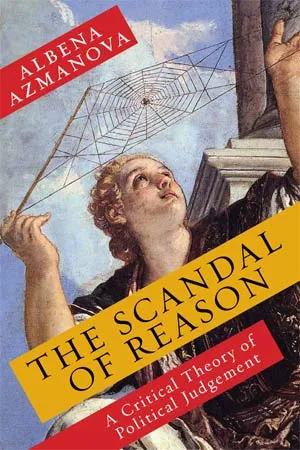
The Scandal of Reason
Albena Azmanova The Scandal of Reason: A Critical Theory of Political Judgment Columbia University Press 296 pages, 6 x 9 inches ISBN 978 0231153805
Available here →March 28, 2012
20120328-azmanova-albena-on-the-scandal-of-reason-3-1
A close-up
The rest of this thread

Albena Azmanova
Albena Azmanova teaches political and social theory at the University of Kent’s Brussels School of International Studies, where she directs the graduate programs “International Political Economy” and “Political Strategy and Communication.” After having taken active participation in the dissident movements and student strikes that brought down the communist regime in her native Bulgaria in 1987-1990, she studied European Law at Strasbourg University, did her doctoral studies at the New School for Social Research in New York, and taught political theory at the Institut d’Etudes Politics (Sciences Po.) in Paris. Her writing focuses on democratic transition and consolidation, European integration, social justice, and the contemporary transformation of political ideologies.
Pull this thread
Judgment should start from the felt sense of injustice, not from ideal theories of justice.
Know something the rest of us don't?
Most threads on Rorotoko begin with our invitation. Any thread can begin with a proposal: you write it with the same prompts every thread answers, and we review it.
Propose a thread →