
Andrew Scull
Desperate Remedies
In Desperate Remedies, I look at American psychiatry, with a few glances at European developments. I examine how the profession of psychiatry came into being in the early nineteenth century, and then trace its evolution, and the ways in which its responses to mental illness have shifted, all the way to the present or as close to the present as publication allows. It’s a complicated story of how mental illness came to be defined as largely a medical issue. I discuss the evolution of our responses to mental illness over the roughly two centuries, beginning with the rise of the asylum era and closing with the era of deinstitutionalization.
The rise of a very narrowly framed notion that mental illnesses are brain disease leads me to discuss some of the problems that I think stem from looking at a very complicated problem through that rather narrow lens. While the term evolution implies some straightforward pathway, I think it’s much more convoluted than that. There is a series of what at the time were seen as revolutions but in retrospect seem to be revolutions that either failed or did not fully live up to their promise. It’s certainly a story of considerable misgivings about how we’ve managed to tackle this problem.
The book is an attempt to both examine the ways in which things have improved to some degree, and to point out the limitations of what we’ve been able to accomplish. In some ways our understanding of mental disturbances remains rather primitive: we don’t really have cures at our disposal but at best we have Band-aids that symptomatically help some people, and unfortunately, don’t help others.
In retrospect, much of the history of psychiatry is rather dismaying. It may be harder to see the problems in the contemporary era than it is to look back and say, how on earth did we slice people’s frontal lobes, and think that was going to cure mental illness; or cause them to have seizures, and think that would do it; or start eliminating bodily organs as a way of treating what was seen as brain disease. How on earth did those interventions arise?
What was the context? What was the impact on patients and their families?
The book strives to foreground the experience of patients by talking about the differential way in which treatments have affected groups, whether one looks at race and its analogues or gender, because it turns out that a remarkable part of the story, and a recurring one, is that men and women tend to be treated somewhat disparately. There’s overlap, but there are also notable differences, particularly in the degree to which these various treatments come to be applied to men and women.
Through the whole two hundred years there are periods of great optimism and periods of immense pessimism about what’s going on. It’s not a linear story of progress by any means. It’s important to see the complexity of this story, and to understand that change doesn’t occur in isolation. What we see happening in the realm of psychiatry, as it comes to be called, is connected with much broader changes in the larger society. Those connections I try to draw out in the book as carefully as I can.
Editor: Judi Pajo
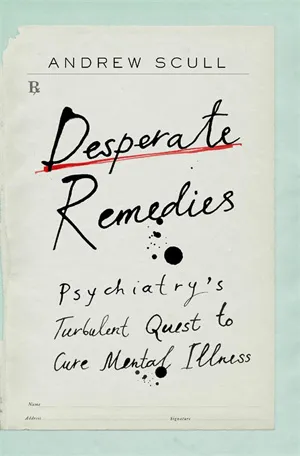
Desperate Remedies
Andrew Scull Desperate Remedies: Psychiatry's Turbulent Quest to Cure Mental Illness Harvard University Press 512 pages, 6 1/8 x 9 1/4 inches ISBN 9780674265103
Available here →May 31, 2023
20161214-scull-andrew-on-madness-civilization-cultural-history-insanity-1-1-1
In a nutshell
The rest of this thread

Andrew Scull
Andrew Scull was educated at Oxford and Princeton, and studied medical history on a post-doctoral fellowship at University College, London. He has held faculty positions at Princeton, the University of Pennsylvania, and the University of California at San Diego, where he is Distinguished Professor of Sociology and Science Studies. He is the author or editor of more than twenty books and more than a hundred scholarly articles. He has written regularly for audiences outside the academy, and his work has appeared in the Times Literary Supplement, The London Review of Books, The Nation, The Paris Review, Scientific American, The Wall Street Journal, and The Los Angeles Times, among others. Madness in Civilization has been translated into more than fifteen languages. Desperate Remedies was listed by the Washington Post as one of the most notable non-fiction books of the year, and it was listed as a book of the year by the (London) Times and the (London) Daily Telegraph.
Pull this thread
Two centuries of psychiatry are a sequence of desperate remedies, and today's biological consensus is the latest one.
Know something the rest of us don't?
Most threads on Rorotoko begin with our invitation. Any thread can begin with a proposal: you write it with the same prompts every thread answers, and we review it.
Propose a thread →