
Andrew Scull
Desperate Remedies
AsylumsIn the early nineteenth century, America, like much of Europe in the same period, embraces the idea that the proper response to serious forms of mental disorder is to put people in institutions, and that occurs in the midst of an extraordinary optimism about what can happen. It’s important to understand, particularly given the awful reputation that asylums later developed, that at the outset asylums were seen as a way of rescuing people from prisons and jails, and from attics and pigsties, and putting them in a therapeutic institution. This was a shift marked by and triggered by a mood of extraordinary optimism, often called the cult of curability, between the 1830s and 1850s.
The expectation was that these new institutions, run along what was called moral treatment lines, would succeed in curing 60 to 80 percent, and maybe even more of the patients, if only people were institutionalized early enough.
In the United States, a remarkable moral entrepreneur named Dorothea Dix traveled the country as a single woman, often on horseback, riding even across the Mississippi floods – it is quite an amazing story – browbeating politicians who ordinarily didn’t listen to women in the nineteenth century, and persuading them that if they built institutions they would not only provide a much more humane alternative to what had gone before, but they would actually cure patients in very large numbers.
That was the premise on which states were induced to build these new institutions.
Then reality struck. I think the small early, charismatically run institutions genuinely did have a powerful impact in their early years, but it proved very difficult to make that routine. What happened once we built state institutions was that the promised cure rate was simply not achievable. Over time that meant a larger and larger fraction of the total patients in confinement were, in fact, chronic patients. If you didn’t exit within the first year or 18 months, chances were, you would only exit in a pine box, and there were often cemeteries attached to these institutions. So asylums grew in size remorselessly. The earliest institutions were 80 or 100 patients. By the end of the nineteenth century asylums of a 1000, 2000, even 5000, 10000, or more, were becoming common. From a period where mental illness was seen as a curable condition, it had come to seem something that by and large was incurable.
To an extent that was an exaggeration. Even in the closing decades of the nineteenth century some of the patients who entered the asylum did recover their wits. Whether that was because of what the asylum did to them, or just because of the passage of time, or some combination of those is neither here nor there. The point is that the fraction of patients being cured had fallen steadily, particularly when it was compared with the overall number of patients under treatment.
Editor: Judi Pajo
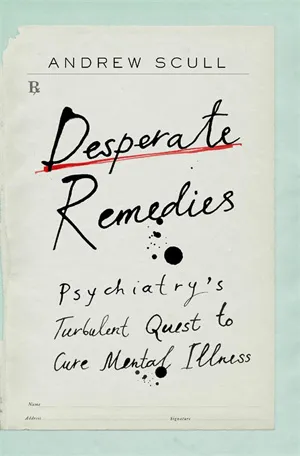
Desperate Remedies
Andrew Scull Desperate Remedies: Psychiatry's Turbulent Quest to Cure Mental Illness Harvard University Press 512 pages, 6 1/8 x 9 1/4 inches ISBN 9780674265103
Available here →May 31, 2023
20161214-scull-andrew-on-madness-civilization-cultural-history-insanity-2-1
The wide angle
The rest of this thread

Andrew Scull
Andrew Scull was educated at Oxford and Princeton, and studied medical history on a post-doctoral fellowship at University College, London. He has held faculty positions at Princeton, the University of Pennsylvania, and the University of California at San Diego, where he is Distinguished Professor of Sociology and Science Studies. He is the author or editor of more than twenty books and more than a hundred scholarly articles. He has written regularly for audiences outside the academy, and his work has appeared in the Times Literary Supplement, The London Review of Books, The Nation, The Paris Review, Scientific American, The Wall Street Journal, and The Los Angeles Times, among others. Madness in Civilization has been translated into more than fifteen languages. Desperate Remedies was listed by the Washington Post as one of the most notable non-fiction books of the year, and it was listed as a book of the year by the (London) Times and the (London) Daily Telegraph.
Pull this thread
Today's biological psychiatry is the latest in two centuries of desperate remedies.
Know something the rest of us don't?
Most threads on Rorotoko begin with our invitation. Any thread can begin with a proposal: you write it with the same prompts every thread answers, and we review it.
Propose a thread →