
Caleb Everett
Numbers and the Making of Us
Numbers, words, and other symbols for precise quantities, are a human invention that had a broad impact on our cognitive and behavioral lives. This claim is based on extensive findings obtained by many researchers across a host of fields including linguistics, psychology, and archaeology. Through a novel synthesis of these findings, Numbers and the Making of Us shows that the invention and refinement of numbers across cultures had a profound impact on the human condition.
A key point underscored in the experimental data surveyed is the following: While even at birth humans have some abilities to differentiate quantities, these abilities are very limited until we are taught number words and counting. We seem to have a native ability to discriminate small quantities from each other, say two from three items. We also have a native ability to discriminate large quantities from each other if they differ in marked ways. We can differentiate, for instance, four from twelve items even at birth.
Surprisingly, perhaps, we require numbers to build upon these basic quantity differentiation skills. Numbers are the conceptual scaffolding that allows us to construct uniquely human quantitative thought. In the book, this point is supported with data from prenumeric children, anumeric adults in places like Amazonia, and members of other species.
So how do humans arrive at numbers if we do not just “grow” into the recognition that, for instance, eight items can be consistently and precisely distinguished from nine items? How were numbers ever invented?
Through the examination of linguistic data across cultures, the book highlights a simple point: Numbers are typically invented after people come to recognize correspondences between the fingers on their hands and other items in their natural environment.
This manual route to numbers is not the only one cultures may take, but it is the most common route. As people come to recognize, in a haphazard and inconsistent manner, that a “hand” of something can refer to a specific quantity (five) of that something, they verbally reify numerical concepts. These verbal numbers can then be passed to others, refined, and built upon. The subsequent construction of more elaborate numerical concepts is essential to the development of other impactful cultural practices like agriculture and writing. In other words, the book suggests that the cognitive tools called numbers helped lead to a reshaping of the lives of most humans.
Editor: Judi Pajo
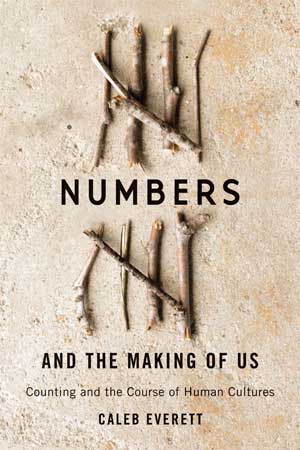
Numbers and the Making of Us
Caleb Everett Numbers and the Making of Us: Counting and the Course of Human Cultures Harvard University Press 312 pages, 5-1/2 x 8-1/4 inches ISBN 978 0674504431
Available here →June 26, 2017
20170621-everett-caleb-on-numbers-making-us-counting-course-human-cultures-1-1-1
In a nutshell
The rest of this thread

Caleb Everett
Caleb Everett is Professor and Chair of Anthropology at the University of Miami. He is an anthropological linguist with a PhD in linguistics from Rice University. Numbers and the Making of Us is his second book. His first book, Linguistic Relativity: Evidence across Language and Cognitive Domains, was published in 2013. He has published articles in venues ranging from general science journals like Proceedings of the National Academy of Sciences to more specialized linguistic journals like Studies in Language. He is a member of the inaugural class of Andrew Carnegie Fellows. His work has been covered in many news outlets.
Pull this thread
Numbers are a human invention, not an inborn faculty.
Know something the rest of us don't?
Most threads on Rorotoko begin with our invitation. Any thread can begin with a proposal: you write it with the same prompts every thread answers, and we review it.
Propose a thread →