
Michael Sappol
Body Modern
Body Modern focuses on the history of a peculiar kind of imagery of the human body: the conceptual scientific illustration. Primarily found in America and Germany between 1915 and 1960, images of the body modern also traveled to the Soviet Union, China, Latin America, and many other countries, as well as across time; the book follows them to the twenty-first century, where they regularly appear in videos, training manuals, websites, textbooks and magazines—our media environment and experience.
To clarify: Body Modern is not about pictures that teach lessons about the anatomical structures of the body, but about pictures that attempt to entertain and instruct readers with visual explanations of the workings of the human body, using metaphors, sequences, analogies, diagrammatic elements, cross-sections, allusions, playful situations, and juxtapositions. To us, such images seem familiar, something that has always been around, but the genre was novel and remarkable when it was invented in Chicago in the first decades of the 20th century.
Its first great exponent was Fritz Kahn (1888-1968), a German-Jewish physician and popular science writer. In collaboration with a cadre of commercial artists, Kahn brilliantly deployed and redeployed––he was a great recycler and repurposer of his own pictures as well as those of his predecessors and contemporaries––thousands of illustrations, in books, articles and posters that reached a mass audience in Weimar Germany and around the world.
Body Modern bombards the reader with images from the works of Kahn because Kahn’s pictures were one very remarkable, but now mostly forgotten, part of a pictorial/media regime change, a cultural revolution that aimed to remake the relationship between text, image, and body, and remake, perhaps re-engineer, human subjectivity.

Head, thorax, and abdomen, all contain gases and help to keep the body afloat in Der Mensch Gesund und Krank (Man in Health and Sickness), vol. 1 (1939).
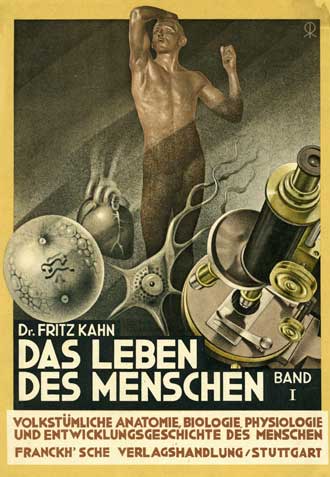
Kahn places “man” in the center, alongside a floating embryo, a nerve cell, a shiny microscope, and a beating anatomical heart in Das Leben des Menschen (The Life of Man), vol. 1 (ca. 1926). © Kosmos Verlag, Stuttgart.
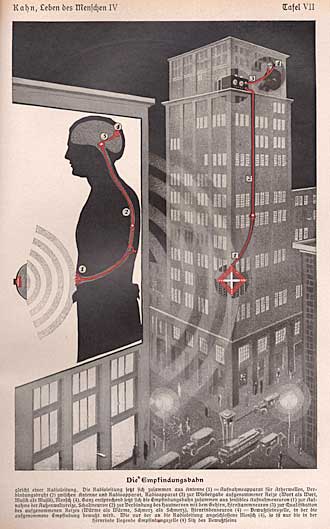
A human body, and, across the street, a parallel diagram showing a radio antenna connected by wire (:nerve) to a radio receiver (:brain) that conveys the sensory input to a man/homunculus listening on headphones (:brain center) in Das Leben des Menschen, vol. 4 (1929). © Kosmos Verlag, Stuttgart.
Editor: Judi Pajo

Body Modern
Michael Sappol Body Modern: Fritz Kahn, Scientific Illustration, and the Homuncular Subject University of Minnesota Press 264 pages, 7 x 10 inches ISBN 978 1517900212
Available here →July 5, 2017
20170705-sappol-michael-on-book-body-modern-fritz-kahn-scientific-1-1-1
In a nutshell
The rest of this thread

Michael Sappol
Michael Sappol lives in Stockholm, Sweden. For many years, he was a historian, curator, and scholar-in-residence at the U.S. National Library of Medicine. His work focuses on the history of anatomy, death, and the visual culture and performance of medicine. He is the author of A Traffic of Dead Bodies (2002) and Dream Anatomy (2006) and co-editor of A Cultural History of the Human Body in the Age of Empire (2010). His latest book, Body Modern: Fritz Kahn, Scientific Illustration and the Homuncular Subject, is featured in his Rorotoko interview. Two new projects, “Anatomy’s photography: Objectivity, showmanship and the reinvention of the anatomical image” and “Queer anatomies: Perverse desire, medical illustration, and the epistemology of the anatomical closet” are in the works.
Pull this thread
Modernity is a historical artifact people had to acquire and perform, and Fritz Kahn's illustrations were among their materials.
Know something the rest of us don't?
Most threads on Rorotoko begin with our invitation. Any thread can begin with a proposal: you write it with the same prompts every thread answers, and we review it.
Propose a thread →