
Michael Sappol
Body Modern
Scholars have long debated modernity, its origins, and its defining characteristics. Body Modern sidesteps those questions. Modernity, it argues, did not descend upon the world like a deus ex machina that re-ordered human consciousness and changed everyone and everything. Instead, Body Modern treats modernity as a historical artifact, the core concept of a 20th-century identity formation.
What makes that tricky is that modernity was a capacious signifier, full of paradoxes. It could absorb anything that seemed to oppose primitive humanity or longstanding tradition, but also anything that opposed the recent past, especially passé versions of the modern. Even the primitive could serve as a signifier of the modern, if it was reframed as a critique of the no-longer-fashionable present, and served up as the latest thing. The modern had to be new.
In the middle decades of the 20th century, a critical mass of people took themselves to be moderns, living in modern times, and felt impelled to live and perform the modern. They sought to cast off local identities and revise traditional ways, to differentiate themselves from what came before. They did that by talking on the telephone, driving cars, wearing modern fashions, reading modern illustrated magazines, listening to new kinds of music on the radio and phonograph, doing new kinds of dances, receiving modern medicines and treatments, going to the movies, taking up new political ideologies, and doing a million other things that signified modern-ness. There was a nearly inexhaustible demand for modernizing devices, objects, methods, presentations and experiences. The public thirsted for the modern.
In this environment, Fritz Kahn pioneered a new kind of image: illustrations that were scientific, metaphorical, and self-consciously modern. In a hyper-illustrated age––where the very abundance of printed half-tone images was itself a signifier of modernity––Kahn’s books on the science of the human featured thousands of illustrations in a variety of modern styles and techniques: surrealism, Art Deco, photomontagery, Bauhaus functionalism, abstraction, Neue Sachlichkeit, sequential art, everyday commercial illustration, etc.
It was a novel and iconophilic approach to popular science, inspired by the media, styles, and genres of the time, especially the illustrated newspaper and magazine. Materials that could help people acquire and perform a “modern” social identity were in demand. Kahn presented himself as an impresario of the modern, a provisioner of images to get modern with. His images were a visual rhetoric of modernity, full of representations of science and technology. More than that, the images themselves worked as a kind of a technology of the self, a modern rhetoric of visuality, which naturalized modernity by situating it within the human body.

Head, thorax, and abdomen, all contain gases and help to keep the body afloat in Der Mensch Gesund und Krank (Man in Health and Sickness), vol. 1 (1939).
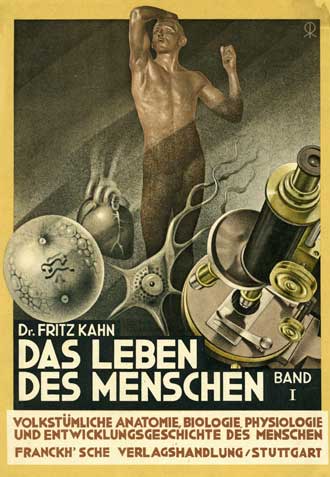
Kahn places “man” in the center, alongside a floating embryo, a nerve cell, a shiny microscope, and a beating anatomical heart in Das Leben des Menschen (The Life of Man), vol. 1 (ca. 1926). © Kosmos Verlag, Stuttgart.
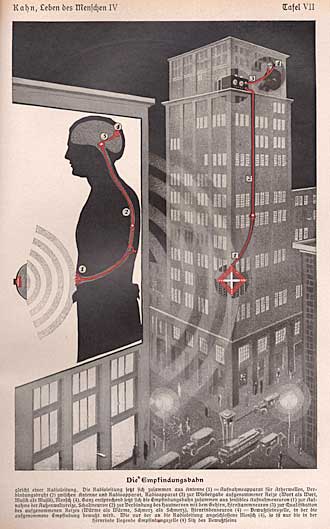
A human body, and, across the street, a parallel diagram showing a radio antenna connected by wire (:nerve) to a radio receiver (:brain) that conveys the sensory input to a man/homunculus listening on headphones (:brain center) in Das Leben des Menschen, vol. 4 (1929). © Kosmos Verlag, Stuttgart.
Editor: Judi Pajo

Body Modern
Michael Sappol Body Modern: Fritz Kahn, Scientific Illustration, and the Homuncular Subject University of Minnesota Press 264 pages, 7 x 10 inches ISBN 978 1517900212
Available here →July 5, 2017
20170705-sappol-michael-on-book-body-modern-fritz-kahn-scientific-2-1
The wide angle
The rest of this thread

Michael Sappol
Michael Sappol lives in Stockholm, Sweden. For many years, he was a historian, curator, and scholar-in-residence at the U.S. National Library of Medicine. His work focuses on the history of anatomy, death, and the visual culture and performance of medicine. He is the author of A Traffic of Dead Bodies (2002) and Dream Anatomy (2006) and co-editor of A Cultural History of the Human Body in the Age of Empire (2010). His latest book, Body Modern: Fritz Kahn, Scientific Illustration and the Homuncular Subject, is featured in his Rorotoko interview. Two new projects, “Anatomy’s photography: Objectivity, showmanship and the reinvention of the anatomical image” and “Queer anatomies: Perverse desire, medical illustration, and the epistemology of the anatomical closet” are in the works.
Pull this thread
Modernity is a historical artifact people had to acquire and perform, and Fritz Kahn's illustrations were among their materials.
Know something the rest of us don't?
Most threads on Rorotoko begin with our invitation. Any thread can begin with a proposal: you write it with the same prompts every thread answers, and we review it.
Propose a thread →