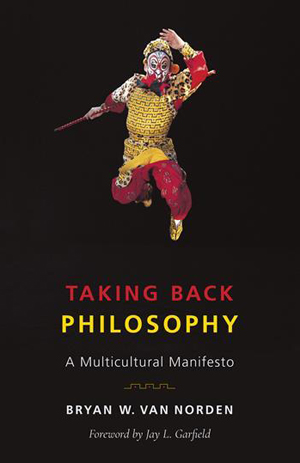
There is much to interest readers in my book beyond a debate about narrow academic curriculum. In one chapter, “Trump’s Philosophers,” I explore how educational demands to “preserve our Western heritage” are intimately connected to explosive political issues. We live in a political environment in which Rep. Steve King (R, IA), can ask during a nationally televised interview, “Where did any other subgroups of people contribute more to civilization” than whites of European descent? Only by teaching people about the contributions of diverse civilizations can we eliminate this sort of arrogance and ignorance.
On a more personal level, I provide examples in my book of how philosophy has inspired people to face real-life challenges. For example, Admiral James Stockdale, who won the Congressional Medal of Honor for his heroism while a Prisoner of War in North Vietnam, said that reading the philosophy of the Stoic Epictetus (55-135) was what allowed him to make it through the war with his dignity and honor intact. Martin Luther King, Jr. reminded his audience in a famous speech that African-Americans W. E. B. Dubois and Alain Locke are serious philosophers that our young people should learn about.
However, he also said that his favorite book after the Bible is Plato’s Republic. He even uses the language and metaphors of Plato’s philosophy in his own famous philosophical essay, “Letter from Birmingham Jail.”
For those who’d like to get a taste of the book, an excerpt has been published in Aeon Magazine. I hope readers of my book will enjoy my take-no-prisoners attack on intellectual parochialism. However, my book also gives people a chance to learn about philosophy (particularly Chinese and Western) in a fun and accessible way. I give a tour of some of the great issues that philosophers discuss, explain why they are important to all of our lives, and show how engaging in a cross-cultural dialogue on these issues is valuable and productive.
If you are a Western philosophy “purist,” parts of this book will enrage you, but other parts will help you see more deeply why philosophy has been around for more than two millennia, and will never go away.My book is not claiming that all Western philosophy is bad and all non-Western philosophy is good. There are people who talk like that, but my book is about tearing down walls, not building new ones. As I say in the book’s conclusion:I too desire to bask in the lunar glow of Plato’s genius, and walk side by side with Aristotle through the sacred grounds of the Lyceum. But I also want to “follow the path of questioning and learning” with Zhu Xi, and discuss the “Middle Way” of the Buddha. I’m sure you and I will not agree about which is the best way for one to live. Let’s discuss it...