
Lynn Keller
Recomposing Ecopoetics
Recomposing Ecopoetics examines 21st-century poetry by a dozen Americans and Canadians who are engaging in their poems with the environmental challenges we currently face. It is, then, a work of environmental literary criticism--or ecocriticism, as it is called in academic circles.
Earlier ecocritical work on poetry focused almost exclusively on nature writing. In the contemporary American context, it attended to poems by Mary Oliver, Wendell Berry, Gary Snyder, and others that depict a seemingly timeless solace found in tranquil rural landscapes or sublime wild ones. Such poetry can connect readers with natural realms that we should indeed value—places worth preserving for their aesthetic or spiritual value as well as their biological importance. However, such poetry’s vision of an essentially unchanging natural world to which one may always escape is in crucial ways inadequate to our present situation of dramatic and often irreversible environmental transformation.
Consequently, my ecocritical study focuses not on soothing or celebratory nature writing but on poetry that reflects a keen awareness of human impact on the planet and of nature’s entanglement in culture. The poetry examined here confronts the homogenization of landscape by extraction industries across the world, explores the impact of toxic chemicals on human and non-human animal bodies, considers the emotional and intellectual challenges of coming to grips with human-induced climate change, attempts to approach the perspectives of the nonhumans with whom humans share an increasingly uninhabitable planet, reminds readers of the inequitable distribution of the benefits and costs of environmental changes associated with industrialization, or juggles a fear of impending environmental apocalypse with hope for its prevention.
Much of this poetry is experimental in its approaches to poetic form and language. Its experimentalism reflects the poets’ hopes that expanding the conventions of literary form or linguistic intelligibility may help push us toward new conceptual structures alternative to the ways of thinking that got us into the environmental mess in which we find ourselves. If I have a particular gift as a literary critic, it is in reading difficult poetry, and my hope is that this book will make difficult yet intellectually and emotionally rich poems accessible to my readers, generating in them an appreciation for this poetry that mirrors my own.
Editor: Judi Pajo
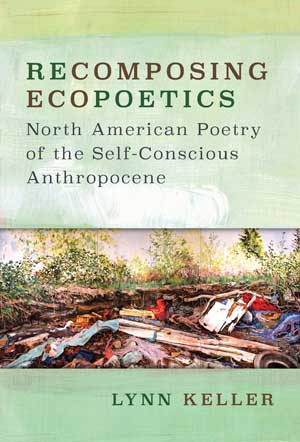
Recomposing Ecopoetics
Lynn Keller Recomposing Ecopoetics: North American Poetry of the Self-Conscious Anthropocene University of Virginia Press 302 pages, 6 x 9 inches ISBN 978 0813940625
Available here →January 15, 2018
20180115-keller-lynn-on-book-recomposing-ecopoetics-north-american-poetry-1-1-1
In a nutshell
The rest of this thread

Lynn Keller
Lynn Keller is the Martha Meier Renk Bascom Professor of Poetry in the English Department at the University of Wisconsin-Madison. There she also directs the interdisciplinary Center for Culture, History, and Environment (CHE) in the Nelson Institute for Environmental Studies. With two colleagues she co-edits the North American Poetry Series of scholarly books published by the University of Iowa Press. Recomposing Ecopoetics: North American Poetry of the Self-Conscious Anthropocene is her fourth book on contemporary poetry.
Pull this thread
Nature poetry of timeless solace cannot meet irreversible environmental change, because its unchanging nature is somewhere to escape to.
Know something the rest of us don't?
Most threads on Rorotoko begin with our invitation. Any thread can begin with a proposal: you write it with the same prompts every thread answers, and we review it.
Propose a thread →