
Lynn Keller
Recomposing Ecopoetics
Each chapter in the book treats work by two or three poets who address a particular issue. That issue might be conceptual—for example, the scalar challenges involved in thinking of human impact in terms of deep time and space, treated in the first chapter, or the complexity of thinking about place (a crucial term for environmentalism) in a globalized world, the focus of chapter 5. Alternatively, that issue might be much more material, as in the problems posed by the accumulation of plastics in our environment, treated in chapter 2, or social, as in the sixth and final chapter that addresses issues of environmental justice. Usually, the chapters begin with a more theoretical framing for the readings of poems that follow. I hope that the intellectually curious reader might open the book to the first page of any chapter, find herself well oriented, and be drawn in.
Since I’ve been asked to choose pages I’d like a browsing reader first to encounter, I’ll settle on the opening of the chapter on the ecopoetics of plastics, “Toxicity, Nets, and Polymeric Chains,” which discusses Evelyn Reilly’s Styrofoam (2009) and Adam Dickinson’s The Polymers (2013). My hope, again, would be that the opening pages would invite the reader to delve into the chapter. I choose that chapter because of the formal interest of the two very different volumes of poetry it examines, because of their compelling acknowledgement of the wonders as well as the dangers of plastic, and because of their inventive exposure of the endocrine disruption caused by plastics that gains too little attention in our plastic-dependent—and plastic-littered—world. Both books are likely to stretch readers’ ideas not only of poetry’s subject matter, but of what poetry looks like and the nature of poetic language.
Reilly’s book, for instance, which explores the mind-boggling scale of plastic’s endurance, contains numerous images and bits of language drawn from the Internet. Her punctuation often evokes domain names (e.g., “What the sea brought: poly.flotsam.faux.foam / &Floam®”), partly to suggest the intertwining of art with marketing and consumerism and partly to suggest the elaborate nets that bind creatures to their environments. That enmeshment makes human and nonhuman animals vulnerable to the endocrine-disrupting and otherwise toxic chemicals that leach from so many plastics—one of the concerns of the poems. In Styrofoam Reilly actively resists the emphasis on transcendence that has characterized much nature writing, believing that it draws people away from a needed focus on this world and its material conditions. Like Reilly, Dickinson includes a number of images in his volume, but the images in The Polymers depict molecular structures, real or invented, of the polymeric chains that intrigue him. His strikingly original book is organized around the seven synthetic resins that predominate in Western petroleum culture, with the initial words of the poems’ titles determined by the chemical make-up of those resins. Believing that we are subject to a vast uncontrolled experiment being conducted by science and industry that is inadvertently rewriting the hormonal instructions governing bodily processes, Dickinson approaches his art as a responding, equally experimental but playful alternative form of science.
Poetry is not generally given much intellectual respect in North America. It tends to be thought of as potentially beautiful, moving, or uplifting, but not to be recognized as also a serious form of intellectual exploration and communication. Nor is it widely seen as a medium that might help us respond meaningfully to momentous societal challenges. My wish would be that Recomposing Ecopoetics might enhance respect for poetry as an intellectually significant art form and, in particular, generate greater appreciation of the power of experimental poetics.
In relation to our current environmental crises, I hope to contribute to people’s recognition of the important role the arts may play, working in tandem with the sciences, to help us address the extensive environmental issues we face. It remains my dream that as a society we will wake up very soon to the seriousness of those issues and respond in ways that do not repeat old patterns where inadequately considered choices have unintentional consequences that contribute to further environmental degradation. I hope that in some small way this book might enhance our care for what we arrogantly but lovingly think of as our Earth.
Editor: Judi Pajo
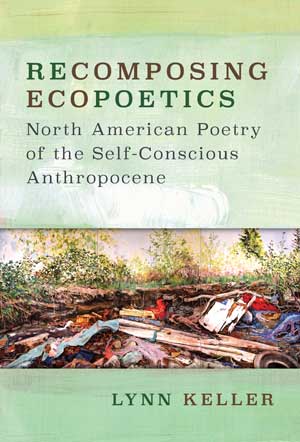
Recomposing Ecopoetics
Lynn Keller Recomposing Ecopoetics: North American Poetry of the Self-Conscious Anthropocene University of Virginia Press 302 pages, 6 x 9 inches ISBN 978 0813940625
Available here →January 15, 2018
20180115-keller-lynn-on-book-recomposing-ecopoetics-north-american-poetry-3-1
A close-up
The rest of this thread

Lynn Keller
Lynn Keller is the Martha Meier Renk Bascom Professor of Poetry in the English Department at the University of Wisconsin-Madison. There she also directs the interdisciplinary Center for Culture, History, and Environment (CHE) in the Nelson Institute for Environmental Studies. With two colleagues she co-edits the North American Poetry Series of scholarly books published by the University of Iowa Press. Recomposing Ecopoetics: North American Poetry of the Self-Conscious Anthropocene is her fourth book on contemporary poetry.
Pull this thread
Nature poetry of timeless solace cannot meet irreversible environmental change, because its unchanging nature is somewhere to escape to.
Know something the rest of us don't?
Most threads on Rorotoko begin with our invitation. Any thread can begin with a proposal: you write it with the same prompts every thread answers, and we review it.
Propose a thread →