
Inderpal Grewal
Saving the Security State
Readers encountering my book might first turn to the chapter on Hurricane Katrina, which captures the context of the book, both with regard to the problems of a retreating welfare state that treats its citizens as aliens and celebrity and heroic humanitarianism. Other chapters follow this first case study, and build on it by showing how the U.S. security state separates out those it favors and those it discards, and how it treats people of color, African Americans, and Muslims. It also shows how U.S. power is viewed around the world via transnational media corporations, such as CNN, and how the images of New Orleans after the Hurricane also impacted the global stature of the United States. Each chapter addresses a different group impacted by security concerns, and readers might turn to these according to their interests with regards to race, religion or gender. Some might also turn to the chapter on humanitarianism, especially the critique of Greg Mortenson’s book, Three Cups of Tea. Many have read this book in schools and colleges so this section of my book will certainly be of interest to those readers.
I would like people to rethink our concern for security within our families and communities, in the country and internationally. We have spent so much money on militaries and the war on terror and yet we still have serious problems with inequality and violence in this country. Weapons manufacturers, digital media and entertainment corporations obsessively focus on weapons, guns, killing and wars. Violence has long been central to entertainment and the connection between the U.S. military and entertainment industry is a long history. Now digital media has expanded this use of violence, still aligned with the military, but also “securitizing” and militarizing communities and families via new technologies. They use violence to profit from us or to control us. Perhaps we need to be less afraid, less paranoid, especially with regard to the diversity of humans among whom we dwell. We have come to believe that every nation-state should be a territorially bounded entity with a racial and linguistic monoculture inside it. That is an incorrect reading of history and a desire that nurtures racism and violence—even fascism. Being less afraid should be a mantra for us. Being less afraid would stop us from surveilling each other and make us less suspicious. Understanding the histories of race, class, religion, ethnicity, gender and sexuality are steps towards this goal. My goal is to have us consider how to make societies less militaristic and less violent.
My other goal is writing this book is to understand that humanitarianism is not a solution to the world’s problems. So much research has now made clear that humanitarianism is at most a band-aid to problems which are complex and large-scale. What we see today around the world are the effects of histories of colonialism on regions of the world that were used mainly for extraction of humans and resources and left in terrible condition. This extraction of people and resources continues—mining corporations are still literally impoverishing indigenous communities globally—and it benefits the wealthy. Humanitarianism cannot correct this. Humanitarianism is about the power of the humanitarian and it shows the inequality, often racial, between the giver and receiver. It simply gives wealthy people, and mostly white Westerners, more power to choose whom, when and where they give help, rather than ending the predatory practices of extraction that creates violence and danger for impoverished communities. This is not to indict advocacy or volunteer work since these are essential to a democracy, but I am concerned that what was the work of the state (providing care and a safety net for all) is now being replaced by volunteer work that is often sporadic, and with little oversight or accountability. Volunteer work should not be a resume builder or something that people do while on vacation or when they retire or if they feel generous or guilty. Advocacy and resistance is work that we should do continually in our everyday lives to force governments to do what is necessary, not just as citizens but as inhabitants of any place on this planet.
Editor: Judi Pajo

Saving the Security State
Inderpal Grewal Saving the Security State: Exceptional Citizens in Twenty-First-Century America Duke University Press 336 pages, 6 x 9.2 inches ISBN 978 0822368984
Available here →February 19, 2018
20180219-grewal-inderpal-on-book-saving-security-state-exceptional-citizens-3-1
A close-up
The rest of this thread
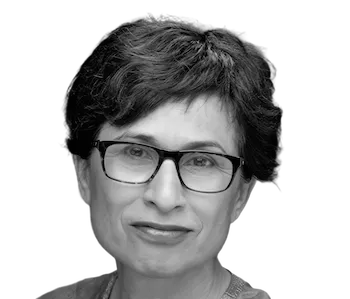
Inderpal Grewal
Inderpal Grewal is Chair and Professor in Women’s, Gender and Sexuality Studies Program, Faculty in the South Asia Council, Ethnicity, Race and Migration Studies Program, and Affiliate Faculty in American Studies and Anthropology at Yale University. She is author of Home and Harem: Nation, Gender, Empire and Cultures of Travel (Duke, 1996), Transnational America: Feminisms, Diasporas, Neoliberalisms (Duke, 2005), and Saving the Security State: Exceptional Citizens in Twenty-first century America (Duke, 2017). She is co-editor (with Caren Kaplan) of Scattered Hegemonies: Postmodernity and Transnational Feminist Practices (University of Minnesota Press, 1995), Introduction to Women’s Studies: Gender in a Transnational World (Mc-Graw Hill, 2001, 2005) and (with Victoria Bernal) of Theorizing NGO’s: Feminism, Neoliberalism and the State (Duke, 2014). Her areas of research include feminist theory, cultural studies of South Asia and its diasporas, British and U.S. imperialism, and global feminist movements.
Pull this thread
US empire is waning, and the security state is the phase in which it turns to war to stay superpower.
Know something the rest of us don't?
Most threads on Rorotoko begin with our invitation. Any thread can begin with a proposal: you write it with the same prompts every thread answers, and we review it.
Propose a thread →