
Greg L. Warchol
Exploiting the Wilderness
I would hope that readers browsing the book would find the section on offenders and the section on solutions. Two highlights are the description of their motivations and methods, and the chart that offers a profile of offender type by species. One common view is that most poaching is done by subsistence hunters seeking food or money for survival. While that is a small part of it, much of the illegal wildlife trade is driven by greed and organized crime. Furthermore, military and paramilitary groups including some terrorist organizations have also been active in elephant poaching in southern and central Africa. I described this in detail in the chapter.Another highlight of the book is the final chapter. Here, solutions to the illegal trade in wildlife are described and analyzed.
These include methods to reduce the supply of illegal wildlife and the consumer demand in end user nations. The programs that I reviewed include some of the earlier efforts such as WINDFALL and CAMPFIRE in Zimbabwe, CARNIVORE in Zambia and the public ivory destructions in Kenya. More recent policies such as the Chinese and US prohibitions on ivory sales and ownership are covered in the chapter. Also described is the UK’s Buckingham Palace Declaration that is a public-private partnership between government and shipping companies to prevent wildlife smuggling.
Finally, I examined the hot topic of hunting-as-conservation or conservation-by-the-gun in this chapter. Public attention to this practice developed out of the so-called Cecil the Lion incident in Zimbabwe a couple years ago. In this case, the Zimbabwean government accused an American hunter and his South African guide of illegally killing a lion during a legal hunt. This led to a hotly debated discussion on trophy hunting. Proponents of trophy hunting argue that it is necessary since the revenue that results is used for conservation. Others contend that it is barbaric and just results in the best examples of a species being killed for a trophy. Even President Trump quickly reversed his recent decision to allow African elephant trophies to be imported into the U.S. citing the cruelty of the practice.
There are not many books describing the illegal wildlife trade. I hope that my work enlightens the reader about the nature and severity of this crime and what is done to control and prevent it. The news about poaching in Africa is often very discouraging. Recent reports of large-scale elephant and rhinoceros poaching can lead one to believe that these animals will disappear from nature. Wildlife populations do recover if poaching can be mitigated. Many new conservation initiatives, including those based on crime theory, can and are helping to prevent the problem. More young university professors beginning their careers are interested in this subject and exploring solutions.
Some of the traditional criminological theories used to explain street crimes are being applied to explain green or conservation crimes.I strongly hope that the book inspires students to become interested in wildlife conservation law and policing. I am using the book in my current university class on wildlife conservation criminology. I hope that it informs students about the problem of wildlife trafficking and encourages some to seek careers in this field, either with a government or nongovernmental agency.
Finally, I would like to have this book read by government policy makers. Wildlife crime is a highly lucrative transnational crime. It ranks in the top three or four types in terms of profit—tens of billions of dollars annually—for criminal enterprises. Some lawmakers may have the view that poaching just involves a few species in select nations. However, nearly any species that can be used for food, decoration, building materials, medicines, clothing, or as a pet is subject to illegal exploitation. The book helps explain how extensive this crime is. The loss of wildlife not only affects the species targeted for the trade, but it represents the loss of valuable economic assets for developing nations dependent on eco-tourism and natural resources.
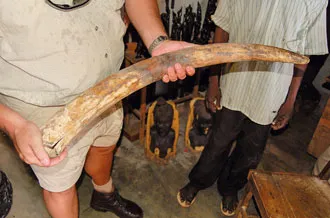
Elephant tusk of questionable origin offered for sale to the author in Mozambique
Editor: Judi Pajo

Exploiting the Wilderness
Greg L. Warchol Exploiting the Wilderness: An Analysis of Wildlife Crime Temple University Press208 pages, 6 x 9 inches ISBN 978 1439913673
Available here →March 5, 2018
20180305-warchol-greg-on-book-exploiting-wilderness-analysis-wildlife-crime-3-1
A close-up
The rest of this thread

Greg L. Warchol
Greg Warchol is a professor of criminal justice at Northern Michigan University. His specialty is wildlife conservation criminology including the illegal trade in endangered African species. Prior to his academic career he was a statistician for the National Crime Victimization Survey, Bureau of Justice Statistics in Washington, D.C. and a supervisor in the Asset Forfeiture Unit, U.S. Attorney’s Office, Chicago, IL.
Pull this thread
African wildlife poaching is organized transnational crime driven by profit, not subsistence hunting, and must be analyzed as crime.
Know something the rest of us don't?
Most threads on Rorotoko begin with our invitation. Any thread can begin with a proposal: you write it with the same prompts every thread answers, and we review it.
Propose a thread →