
Craig Stanford
The New Chimpanzee
Most readers tell me they are most intrigued by the Machiavellian politics that define chimpanzee social life; and indeed, increasing evidence of violence may shed light on the nature of violence in our own species. Chimpanzees use aggression in ways that repulse us when we see it in in our own species. My colleague Christopher Boehm estimated that the rate of non-lethal violence among wild chimpanzees is greater than that of most human societies.
A separate study by Richard Wrangham and his coauthors found a similar “murder” rate between chimpanzees and traditional human hunter-gatherer societies, but also a much higher rate of nonlethal aggression by chimpanzees. Chimpanzees are the only primate other than ourselves who routinely kill one another in the name of territory and resources. Male chimpanzees lack the weapons we associate with efficient killers; they have hands and fingernails, not paws and claws.
Their canine teeth, while impressive, are no match for those of a carnivore. And yet they carry out grisly attacks on members of their own and especially neighboring communities. Males sexually coerce females. And both males and females are known to commit infanticide.
Chimpanzees are not killing machines; ninety-nine per cent of their lives are spent in peace. Of course, the same could be said about us. The potential for violent behavior is within each of us, but it surfaces only rarely, or never at all. And just as humans have myriad ways to defuse disputes before they reach a stage at which violence seems a feasible option, chimpanzees have many fail-safes that prevent lethal aggression from taking place.
After minor squabbles they reconcile, and the ways in which they restore social harmony are as interesting and important as the violence that gets all the attention from scientists and the media.Like every other mammal on the planet, chimpanzees have the capacity to inflict physical harm on one another. It’s harder to take a utilitarian approach to violence in chimpanzees than it is in lower mammals. Chimpanzees who injure or kill one another are not immoral.
They are amoral; their violence is a means to reach an end. We don’t get angry at lions for attacking each other or for killing zebras; it’s what lions do. We tend to view great apes in a different light because of their close evolutionary connection to us. An entire wing of animal behavior research is founded on the idea that the roots of human morality may be found in the pre-moral behavior of nonhuman primates, with chimpanzees serving as a prime animal model.
Most researchers have concluded that “might makes right” when it comes to chimpanzees’ treatment of one another. Anthropologists have, for many years, cited chimpanzee aggression as an example of how punitive violence may have its cultural origins in our own species.
My hope is that the reader will appreciate chimpanzees for what they are: not under-evolved humans, nor caricatures of ourselves, but perhaps the most interesting of all the species of nonhuman animals with which we share our planet. The gift of the chimpanzee is the vista we are offered of ourselves. It is a gift that is in danger of disappearing, as we destroy the chimpanzee’s natural world and drive them toward extinction.
A tiny fraction of chimpanzees lives in protected sanctuaries, where their health is monitored, and we are aware of every problem that faces them. The other 150,000 chimpanzees living in the forests of Africa are still unknown, unmonitored, and in dire need of protection. The point of reading The New Chimpanzee is to gain a fuller sense of what we will lose if chimpanzees cease to exist in the wild.
Editor: Judi Pajo

The New Chimpanzee
Craig Stanford The New Chimpanzee: A Twenty-First-Century Portrait of Our Closest Kin Harvard University Press260 pages, 6 1/8 x 9 1/4 inches ISBN 978 0674977112
Available here →June 11, 2018
20180611-stanford-craig-on-book-new-chimpanzee-twenty-first-century-portrait-3-1
A close-up
The rest of this thread
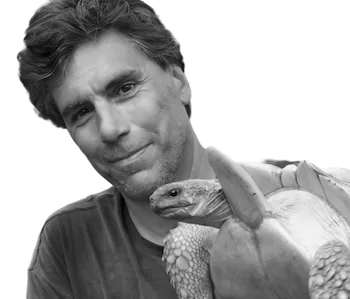
Craig Stanford
Craig Stanford is Professor of Biological Sciences and Anthropology at the University of Southern California. He has conducted field research on chimpanzees and other animals for 30 years in Africa and Asia. He is best known for his research on chimpanzee hunting and meat-eating in Gombe National Park, Tanzania, in collaboration with Jane Goodall. Stanford holds a Ph.D. from UC Berkeley and is the author of 16 books and 150 articles on animal behavior and conservation. His research has been supported by numerous grants from the National Science Foundation, the Fulbright Foundation, and the National Geographic Society, among others. His most recent book is The New Chimpanzee: A 21st Century Portrait of Our Closest Kin. He is deeply involved in wildlife conservation and lectures around the world on the need to preserve biodiversity in all its forms.
Pull this thread
Chimpanzee killing is amoral, a means to an end, and the reconciliation that normally prevents it deserves the attention.
Know something the rest of us don't?
Most threads on Rorotoko begin with our invitation. Any thread can begin with a proposal: you write it with the same prompts every thread answers, and we review it.
Propose a thread →