
Alastair Bonnett
Beyond the Map
Beyond the Map is the kind of book you can dip into anywhere. Reviewers often call it ‘quirky’ and the individual chapters are very different from each other; some are sombre (for example, the chapter on the geography of the Islamic State) but many are playful (for example, the chapter where I tell the story of how my street declared independence from Britain after the UK’s ‘Brexit’ vote).
Playful or not, every chapter investigates our changing and curious relationship with place. A good example is my attempt to find a legendary ‘phantom tunnel’ in the busiest train station in the world. About four million people a day pass through the countless levels, 200 exits and 36 platforms of Shinjuku Station in the heart of Tokyo. It is a temple of efficiency and signage, but there is a legend attached to it. It’s not a legend from days of yore; it’s a modern legend that reflects the fears and fantasies that come to life in an overwhelming metropolis.
Sometimes called the Bermuda Triangle of Tokyo, the story goes that some commuters never make it home. They take a wrong turn, then another, get flustered, run down the wrong stairs and end up in the wrong elevator, until they find themselves quite alone in a quiet corridor, the soft boom of a distant underground train sounding somewhere far above them. They are never seen again.
On a hot and humid day in late August I entered Shinjuku’s maw. It’s not rush hour, but people are pouring through the broad, immaculately clean and well-signed corridors. I thought I’d need to get through the ticket barriers to go into the belly of this thing, but after some toing and froing through a few of them, with the assistance of some puzzled staff (the barriers here open to let you in, but if you haven’t gone anywhere they won’t let you out), I’m finding that the loneliest spots are in the meeting ground between the station and the giant shopping complex that engulfs it. For all its many exits and corridors, the station is just one element of a much bigger labyrinth. It is in this interzone where the crowds thin out and I am able to worm my way down deeper and deeper, heading into the furthest and quietest corners of the labyrinth. It takes about twenty minutes, down an escalator, down some more stairs and another escalator, before I’m anywhere that isn’t a major thoroughfare. It’s a stairwell with no signage and I head down again; and here the noises of the crowd have softened to almost nothing. It’s a beguiling contrast; the idea of ever returning up there, I suddenly realise, is deeply unappealing. It’s so nice to hear the clip of my own footsteps. The lighting here is not so bright, the cleaning regime less evident; there are even a few items of litter, blown down from above, and a man is slumped against a huge paper shopping bag on the flight below me. He’s very still, his unseeing eyes focused on nothing ...There is a growing feeling that the replacement of unique and distinct places by generic blandscapes is severing us from something important. If only in a small way, I hope Beyond the Map contributes to this pushback. Both this book and its prequel, Unruly Places, have been widely translated, finding readers in Korea and China, as well as in Germany and Spain. As the tide of globalization and urban change sweeps the planet so too does a fascination with unique, intriguing, storied places. They have become redoubts of the imagination. We need these places, and the sooner planners, developers, authorities of all sorts, get that and stop shredding our landscapes and our memories, the better.
Another task I want to aid in Beyond the Map is the reinvention of exploration. Exploration is a rather tarnished concept because it conjures images of colonialism and one group of people pushing another out of the picture. But the desire to explore cannot be defined around one historical event or period. It is an innate human attribute and one of our species’ most glorious qualities. For me, exploration today means understanding that, despite the best efforts of Google Earth, our world is still full of the unexpected and uncharted. Such regions may be beneath the waves or nearby; they may require long, difficult journeys or we may walk straight past them every day. The distance traveled is irrelevant: real exploration does not test our wallets or our shoe leather but our imagination.
Editor: Judi Pajo
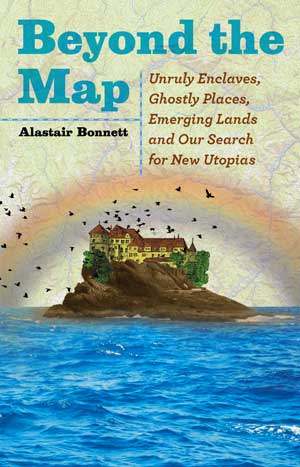
Beyond the Map
Alastair Bonnett Beyond the Map: Unruly Enclaves, Ghostly Places, Emerging Lands and Our Search for New Utopias Chicago University Press 304 pages, 5 1/2 x 8 1/2 inches ISBN 978 0226513843
Available here →February 20, 2019
20190220-bonnett-alastair-on-book-beyond-map-unruly-enclaves-ghostly-places-3-1
A close-up
The rest of this thread

Alastair Bonnett
Alastair Bonnett is a professor of geography and travel writer. His books have been translated into nineteen languages and include What is Geography?; Unruly Places; The Geography of Nostalgia; and An Uncommon Atlas. He is currently finishing a new book on artificial and disappearing islands called The Age of Islands (University of Chicago Press). Alastair lives in Newcastle in the UK.
Pull this thread
The world is riddled with hidden and emerging places, and real exploration tests imagination, not distance travelled.
Know something the rest of us don't?
Most threads on Rorotoko begin with our invitation. Any thread can begin with a proposal: you write it with the same prompts every thread answers, and we review it.
Propose a thread →