
William L. Silber
The Story of Silver
I would urge the reader to start with the Introduction, called Obsession, which provides a bird’s eye view of how silver has seduced investors and politicians throughout the ages, and then turn to the last chapter, called The Past Informs the Future, which focuses on the transformation of the white metal from soft money during the nineteenth century to hard asset today. The discussion focuses on the worldwide experiment in fiat currency, pure paper money, which began on August 15, 1971, when President Nixon suspended the right of foreign central banks to convert dollars into gold. The experiment almost failed at the start. The newly-designed freedom from precious metals allowed America’s central bank, the Federal Reserve System, to deliver easy credit in response to political pressure, spawning the Great Inflation of the 1970s and nearly destroying the U.S. dollar. But the chaos unleashed popular support for making price stability the primary objective of an independent central bank.Since then, central bank independence throughout the world has replaced gold and silver as guardian of the currency. And if central bankers do their job that arrangement will continue but public support can evaporate, undermining banker resolve. The U.S. Congress, for example, can abolish the Federal Reserve with a simple majority vote, suggesting that America’s central bank might run a printing press when rising interest rates bring an avalanche of protest to Capitol Hill. The Federal Reserve has survived the fifty-year trial of fiat currency, but that period is less than a heartbeat in world history. The Soviet Union’s experiment with communism challenged America for world domination for the better part of the twentieth century before expiring like the worthless paper currency of Germany’s Weimer Republic. Central bankers remain on trial, and the uncertain verdict sustains the ancient role of gold and silver as storehouses of value in the new millennium.Here are the main “takeaways” from the book: First, FDR ignored how the Silver Purchase Act inadvertently encouraged Japanese aggression in the 1930s, demonstrating the danger of formulating domestic policy without reference to international consequences. It is a cautionary lesson for putting America First today, especially since the fallout from such narrow-minded policymaking may not materialize until it is too late, just like back then.Second, the ongoing world-wide experiment in fiat currency that began in 1971 has succeeded so far but 50 years is a heartbeat in world history. Uncontrolled spending by the federal government in a fully-employed economy suggests that precious metals like gold and silver belong in every portfolio to hedge against a failure by central bankers to avoid the political pressure to run a printing press.Third, silver has been more than just an investment vehicle for Americans like Nelson Bunker Hunt and Warren Buffett; it has been part of the country’s monetary system since the founding of the Republic and is woven into the fabric of our history like the stars and stripes.Fourth, investors like Warren Buffett discovered that silver is like a switch hitter in baseball, an industrial batter but also comfortable from the precious side of the plate. Silver soared like gold after Lehman’s bankruptcy in 2008, unlike copper and oil which collapsed along with the stock market.
Editor: Judi Pajo
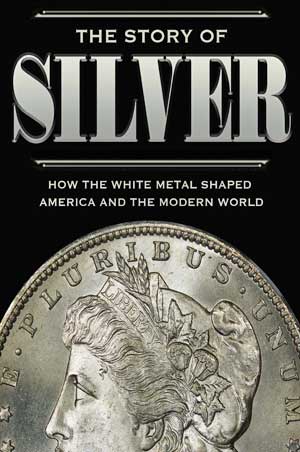
The Story of Silver
William L. Silver The Story of Silver: How the White Metal Shaped America and the Modern World Princeton University Press328 pages, 6 1/8 x 9 1/4 inches ISBN 978 0691175386
Available here →May 8, 2019
20190508-silber-william-on-book-story-silver-how-white-metal-shaped-america-3-1
A close-up
The rest of this thread
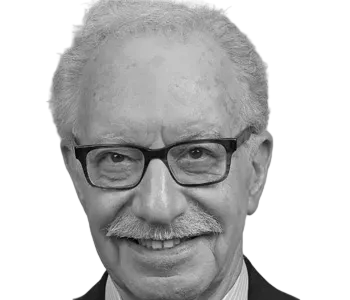
William L. Silber
William L. Silber is the Marcus Nadler Professor of Finance and Economics at the Stern School of Business, New York University. He was voted Professor of the Year by MBA students in 1990, 1997, and 2018, and was awarded NYU's Distinguished Teaching Medal in 1999. In the past he managed an investment portfolio for Odyssey Partners, was a Senior Vice President, Trading Strategy, at Lehman Brothers, was a Senior Economist with the President's Council of Economic Advisors, and was a member of the Economic Advisory Panel of the Federal Reserve Bank of New York. He holds an M.A. (1965) and Ph.D. (1966) from Princeton University and is a graduate of Yeshiva College (1963). He has written eight books, including a biography of former Federal Reserve Chairman, Paul A. Volcker, entitled VOLCKER: The Triumph of Persistence (Bloomsbury, 2012). The biography was named the China Business News 2013 Financial Book of the Year, was a finalist in the Goldman Sachs and Financial Times 2012 Business Book of the Year Award, was named “One of the Best Business Books of 2012” by Bloomberg Businessweek, and was listed as “One of 2012’s Great Leadership Books” by the Washington Post.
Pull this thread
Roosevelt's silver purchases drained China of silver and helped Japan subjugate it.
Know something the rest of us don't?
Most threads on Rorotoko begin with our invitation. Any thread can begin with a proposal: you write it with the same prompts every thread answers, and we review it.
Propose a thread →