
Susan Schulten
A History of America in 100 Maps
I have a longstanding interest in old maps. My last book, Mapping the Nation, traced a sea change in the way that Americans and Europeans thought about and used maps across the nineteenth century. In 1800, most maps were either representations of the physical terrain or tools of navigation. By 1900 the explosion of “thematic” maps revealed that maps had come to be used not just to navigate the land, but as tools of analysis, communication, and visual representation.
Over the course of the nineteenth century, maps appeared across all areas of American life. Medical men turned to maps in an urgent quest to solve the deadly mysteries of yellow fever and cholera. Anti-slavery activists creatively used maps to persuade an ever-growing public to oppose the expansion of this institution into the western territories. And after the Civil War, the federal government actively began to translate census data into cartographic form in an effort to administer an increasingly diverse population. To illustrate the power of this shift in the meaning of maps, I developed a website. Today we live in a world saturated with maps and graphic information: Mapping the Nation explains how we got to this point.
While researching Mapping the Nation, I came to appreciate the extraordinary power that maps have not just to reflect but also shape historical change. Thereafter, I began to visualize a history of North America that was not just illustrated by maps, but explored through maps. Such a book hinges on the details of presentation, so that the educated general reader as well as the professional historian can appreciate the way maps mattered in history. The result is a book using maps to explore everything from the forces that governed settlement across North America to the battles across the western front in the Second World War.
In A History of America in 100 Maps, I avoid theoretical frameworks in order to foreground the meaning and use of the maps themselves. Such an approach reminds us that history was lived not just chronologically, but spatially. I also prioritized maps that challenged assumptions and familiar narratives, hoping to reframe the past in a way that would highlight the uniqueness of these graphic materials. For instance, an early eighteenth-century deerskin map forces us to recognize the fragility of the South Carolina colony relative to the native tribes of the Southeast in the 1710s. Several pages later, readers will find an 1832 map designed to teach geography to the blind, an image which captures crucial efforts to widen education in the antebellum era.
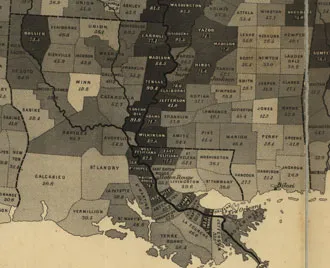
Zoom-in of image below.
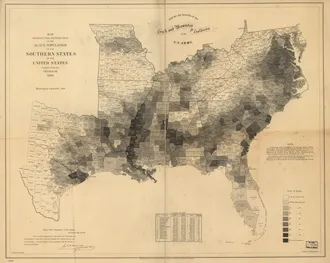
The United States Coast Survey produced this path-breaking map of census data in 1860, a document Lincoln used to make sense of the Confederacy and its greatest resource: slavery. Library of Congress.
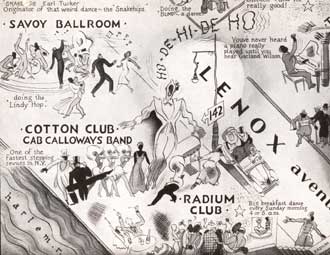
Zoom-in of image below.
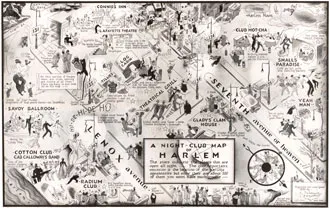
Elmer Simms Campbell’s raucous map of Harlem in the Jazz Age richly captures the energy and chaos of that moment. Library of Congress.
Editor: Judi Pajo

A History of America in 100 Maps
Susan Schulten A History of America in 100 Maps University of Chicago Press 256 pages, 8 1/2 x 11 inches ISBN 978 0226458618
Available here →June 26, 2019
20190626-schulten-susan-on-book-history-america-100-maps-2-1
The wide angle
The rest of this thread

Susan Schulten
Susan Schulten is Professor of History at the University of Denver, where she has taught since 1996. Her previous books include The Geographical Imagination in America, 1880-1950 (Chicago, 2001) and Mapping the Nation: History and Cartography in Nineteenth-Century America (Chicago, 2012). She is also co-editor, with Elliott Gorn, of Constructing the American Past: A Sourcebook of a People’s History. Readers can explore A History of America in 100 Maps at www.america100maps.com.
Pull this thread
Maps are not illustrations of history but forces that drive it.
Know something the rest of us don't?
Most threads on Rorotoko begin with our invitation. Any thread can begin with a proposal: you write it with the same prompts every thread answers, and we review it.
Propose a thread →