
David M. Struthers
The World in a City
I’d suggest opening the book to Chapter 6 on the Baja Raids. In winter and spring 1910/1911 the Partido Liberal Mexicano (PLM) organized a military incursion across the U.S.–Mexico border in Baja California during the opening of the Mexican Revolution. This was part of an upsurge in radical and militant actions in California and the borderlands between 1910 and 1912, including the Los Angeles Times bombing, Fresno’s IWW free-speech fight, and the bombing of Los Angeles’s Llewellyn Iron Works.
This chapter details regional coalition building and the transnational support structure for the Baja Raids. Fighting began in Mexicali when a group of less than twenty Mexicans slipped across the border and seized the town’s jail. Word quickly spread and a group of white and African Americans, mostly IWW members, soon joined the fight.
Eventually anarchists and adventurers from across the United States and Canada made the journey. Many were European immigrants from England, Russia, Germany, Sweden, and France, with Italians of special significance. Australians, Boers, Chinese, and Japanese also joined. Pandurang Khankhoje from the South Asian Ghadar Movement even paid a visit to the front lines.
Large numbers of Native Americans also fought, including Cocopah, Diegueño, Kiliwa, and Papai. The force’s international composition remained unmatched until antifascist organizing during the Spanish Civil War and its interracial dimension was still more significant. The racial diversity of participants increased the overall number of rebels and contributed to the effectiveness of the military force. But conflicts between rebels and then with the adventurers and interlopers who crossed the border contributed to questions over the legitimacy of the raids.
These conflicts arose as it became clear that the Baja California front was a sideshow to the Mexican Revolution and that the PLM leaders in Los Angeles, though they had many supporters and sympathizers, did not exert direct control over militias anywhere else in Mexico.I argue that the lack of military or political success of the cosmopolitan army should not constrain the historical legacy of the PLM-led insurgency in Baja California.
The PLM functioned as a funnel of interracial internationalism during the outbreak of the Mexican Revolution by channeling financial and material resources and people through Los Angeles. The flows of people and ideas back out through the connected movement increased the scale of discord over its failure in the years that followed.
The Baja raids are an example of the potential of militant cosmopolitan revolutionary action. They are also a cautionary tale of the difficulties of bringing such a diverse group together—on the front lines of battle and mediated through print to a global movement—with an impulse for internationalism yet little understanding of the distinct cultural and ideological differences in what people most often viewed as their shared revolutionary struggle.
The book has distinct lessons for different audiences. For historians and other scholars, I think that affinity is a useful tool applicable to other periods and locations. There are many instances of racial divisions being altered by distinct local power relationships. Two quick examples: A “sawbuck equality” developed between enslaved and owners in South Carolina in the late 1700s, and the cosmopolitan lower decks of ships in the Atlantic during the Age of Revolution provided space for whites, blacks, and many others to find common ground. Affinity can help us understand flexible forms of association in relation to race, power, and states.
For most readers, the implication is that the broadest moments of interracial organizing were brief and came outside of hierarchical organizations. Stronger power structures focused institutional power to enforce racism in these organizations and parties. Interracial affinities developed their broadest form in places that lacked the organizational structures to enforce racist exclusion. When whites in these spaces held deeply racist beliefs, they had less power to act upon these beliefs; all the while, the structural manifestations of race still organized society and the economy.
In our era of increasingly vocal racism and nationalism, the book has a powerful story to tell about people that fought to create a world counter to these noxious beliefs. One place for us to start is learning that the mix of organizers, workers, and migrants in the book didn’t have superpowers. They didn’t have it all figured out, but what they knew was that to make a better world was to struggle. In the end, we can all work to continue their rich cultural tradition of mutual solidarity.
Anarchists, syndicalists, and socialists brought interracial, multilingual, and international organizing to the center of regional working-class culture through their struggle to bring their visions of a new social and economic order into reality. It’s up to us to retranslate these practices and invent our own today. This book illustrates that the pull of cooperation could be stronger than the will for division for many residents of Los Angeles. Only through struggle can we make a culture of affinity as much their legacy as our own.
Editor: Judi Pajo
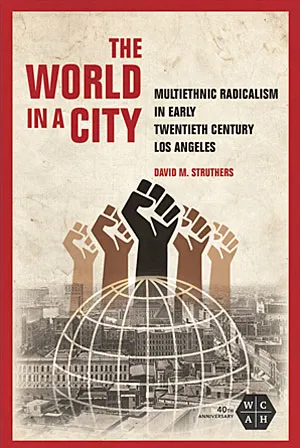
The World in a City
David M. Struthers The World in a City: Multiethnic Radicalism in Early Twentieth-Century Los Angeles University of Illinois Press310 pages, 6 1/8 x 9 1/4 inches ISBN 978 0252084256
Available here →December 11, 2019
20191211-struthers-david-on-book-world-city-multiethnic-radicalism-early-3-1
A close-up
The rest of this thread

David M. Struthers
David Struthers is a historian with interdisciplinary pursuits including radicalism, immigration, race, cities, and media. David received their PhD in history from Carnegie Mellon University. Based in Copenhagen, Denmark, David has lectured at the University of Copenhagen and the Copenhagen Business School over the last ten years. Their monograph, titled The World in a City: Multiethnic Radicalism in Early Twentieth Century Los Angeles (University of Illinois Press, 2019), explores the dynamics of a city and region with a rapidly developing economy and large-scale immigration. The book just won the Shelley Fisher Fishkin Prize from the American Studies Association (2019). Their volume Wobblies of the World: A Global History of the IWW (Pluto Press, 2017), edited with Peter Cole and Kenyon Zimmer, is the first global history of the Industrial Workers of the World. David is currently working on a monograph on the history of social media before the Internet.
Pull this thread
The broadest interracial solidarities in American history formed where organization was weakest, among migratory workers outside unions and parties.
Know something the rest of us don't?
Most threads on Rorotoko begin with our invitation. Any thread can begin with a proposal: you write it with the same prompts every thread answers, and we review it.
Propose a thread →