
David M. Struthers
The World in a City
The near-continuous movements of people and of ideas are two themes that flow through the work. Migration from within the United States and across international boundaries increased the population of Los Angeles from roughly one hundred thousand in 1900 to over one million people in 1930. This created one of the most racially diverse places in terms of breadth in the United States and probably the world in this period.
The new arrivals filtering into the city formed multiracial working-class neighborhoods.
An important thing to recognize about Los Angeles is that it had a very small industrial sector before 1920; the regional agricultural economy was far more advanced in terms of scale and corporate organization. This shaped migratory labor patterns typified by urban-rural and rural-rural movement where itinerate workers migrated between seasonal agriculture jobs and infrastructure work—things like laying railroad tracks, building roads, and digging aqueducts—and then back to “winter” in Los Angeles or other locations.
As the city’s population increased, migration continued for a large sector of the population.
As workers traveled, they formed social connections at the sites of their labor, along the path of their journeys, and independent of their work in places often hundreds of miles away; they formed communities as dispersed, flexible, and mobile as their lives.
The mobile working class extended the reach of Los Angeles’ diverse urban community through layers of interconnected social ties that reached throughout the U.S. West and Mexico and into the broader world. Radical political ideals carried by people and print traversed the same commodity and migration networks into and out of Los Angeles.
My interest lies in the alliances people formed to improve their lives in this period of settler colonialism and U.S. imperialism. The most racially diverse coalitions formed among workers with precarious employment and living situations in spaces with weak organizational structures, fueled by the ideals advanced in anarchism—especially by the Partido Liberal Mexicano—the syndicalism of the Industrial Workers of the World (IWW), and socialist internationalism.
Radicals generated novel forms of multilingual and interracial organizing by rearticulating anti-statist and internationalist streams of thought to create a local internationalism rooted in place. These practices had a broad cultural impact.
The radical practices that germinated in and near Los Angeles gave rise to some of the broadest interracial solidarities in the history of the United States as Mexicans, European immigrants, Japanese, South Asians, African Americans, indigenous, and native-born whites often found cause for cooperation. Though these solidarities constantly reformed, shifted, and dissolved in a multiracial city during a period of remarkable economic development and population growth.
Radicals did not reverse the powerful economic forces and racist logics fueling Los Angeles’ rapid growth, but their organizing provided important outlets for working-class people to shape their lives with hope for a better world.
Editor: Judi Pajo
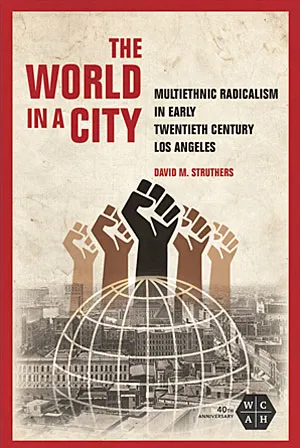
The World in a City
David M. Struthers The World in a City: Multiethnic Radicalism in Early Twentieth-Century Los Angeles University of Illinois Press 310 pages, 6 1/8 x 9 1/4 inches ISBN 978 0252084256
Available here →December 11, 2019
20191211-struthers-david-on-book-world-city-multiethnic-radicalism-early-1-1
In a nutshell
The rest of this thread

David M. Struthers
David Struthers is a historian with interdisciplinary pursuits including radicalism, immigration, race, cities, and media. David received their PhD in history from Carnegie Mellon University. Based in Copenhagen, Denmark, David has lectured at the University of Copenhagen and the Copenhagen Business School over the last ten years. Their monograph, titled The World in a City: Multiethnic Radicalism in Early Twentieth Century Los Angeles (University of Illinois Press, 2019), explores the dynamics of a city and region with a rapidly developing economy and large-scale immigration. The book just won the Shelley Fisher Fishkin Prize from the American Studies Association (2019). Their volume Wobblies of the World: A Global History of the IWW (Pluto Press, 2017), edited with Peter Cole and Kenyon Zimmer, is the first global history of the Industrial Workers of the World. David is currently working on a monograph on the history of social media before the Internet.
Pull this thread
The broadest interracial solidarities in America formed where organization was weakest.
Know something the rest of us don't?
Most threads on Rorotoko begin with our invitation. Any thread can begin with a proposal: you write it with the same prompts every thread answers, and we review it.
Propose a thread →