
Micheline R. Ishay
The Levant Express
When the Arab Spring began, I had an unusual vantage point. Living in the United Arab Emirates as a visiting professor, I was teaching one of the first human rights courses in the Arab World when protesters started flooding the streets in Tunis, Cairo, and beyond. The UAE was in the eye of this historical storm, and I was meeting regularly with diplomats, world leaders, scholars, and journalists. I had the privilege of teaching politicians and members of the Emirati ruling family, learning about their hopes and fears as upheaval shook the region. I also traveled extensively to hear from some of the people who were most affected, from human rights activists to refugees from civil wars. As a human rights scholar trained in political philosophy and history, I recognized patterns of revolutionary contagion and anticipated the turning points at which these uprisings would falter or come to fruition. Those insights are represented in this book, in which I carry on the tradition of progressive realists—a category that includes people as diverse as Franklin Roosevelt and Antonio Gramsci—as I attempt to untie the Gordian knots that prevent a regional peace predicated on economic development and the advance of human rights. I consider how the pendulum, which has moved since 2013 from Enlightenment to counter-Enlightenment, can swing back toward a sustainable Enlightenment pole. These arguments remain relevant as protesters return today to Arab streets, and as repressive regimes face new domestic and international pressures.
The train of human rights progress, the Levant Express, is more than just a metaphor. I also propose (among other developmental projects) restoring an abandoned rail network—the Hejaz train that once connected major cities in the Middle East—as a way to reinvigorate the economy and connect people from different parts of the region. I am not the only one to see the potential of this idea, which is capturing the imagination of several non-Western countries. The vision of a Middle East connected by high-speed rail, new roads and trade routes is attracting financial, commercial, and governmental interest, spearheaded by China; and the West would do well to pay attention.
The book is filled with other details about this and other actual and planned regional projects consistent with basic human rights aspirations. It is informed by a deep understanding of political theory, history, economics, and law—fields that often are marginalized within Middle Eastern studies. But it is also highly readable and light on academic jargon, and very accessible to a nonacademic audience. Artwork, maps, poetry and rap lyrics are used to dramatize events that led to the changing political seasons since the Arab uprisings—and to stir the imagination about what could possibly happen in the future.
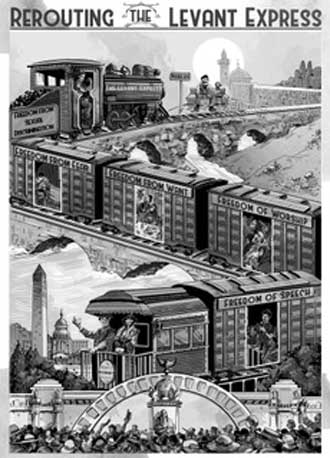
Drawing by Brooke VanDevelder.
Editor: Judi Pajo
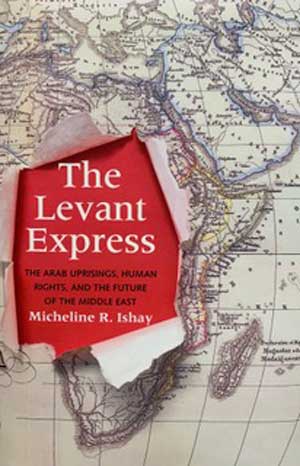
The Levant Express
Micheline R. Ishay The Levant Express: The Arab Uprisings, Human Rights, and the Future of the Middle East Yale University Press 352 pages, 6 1/8 x 9 1/4 inches ISBN 978 0300215694
Available here →February 19, 2020
20200219-ishay-micheline-on-book-levant-express-arab-uprisings-human-rights-2-1
The wide angle
The rest of this thread

Micheline R. Ishay
Micheline Ishay is Distinguished Professor of International Studies and Human Rights at the Josef Korbel School of International Studies at the University of Denver, where she serves as Director of the International Human Rights Program. She is an affiliate faculty member with the Center for Middle East Studies and in 2008 was named University of Denver Distinguished Scholar. She has held visiting professorships at Hebrew University, Jerusalem and Khalifa University, Abu Dhabi, United Arab Emirates, along with fellowships at the University of Maryland and the Bellagio Center (Rockefeller Foundation) in Italy.
Pull this thread
The Arab uprisings follow a recognizable pattern of revolution and counterrevolution, and women will most likely restart the advance.
Know something the rest of us don't?
Most threads on Rorotoko begin with our invitation. Any thread can begin with a proposal: you write it with the same prompts every thread answers, and we review it.
Propose a thread →