
Micheline R. Ishay
The Levant Express
An accomplished artist, Brooke VanDevelder, worked with me to create customized illustrations that serve as frontispieces for each of the book’s three sections. If a potential reader is just browsing, those images will provide a fitting introduction to the spirit and content of each section. Those who have a little more time will appreciate the brief introductions to each of the book’s three parts, along with the overall introduction to the book. That’s where I tell some of my own story, even including a personal poem called, “Farewell to Abu Dhabi,” and where I outline the main themes of the book.
I suspect that some readers will jump to particular chapters to see what I have to say about issues in which they are most engaged. For example, the chapters “Frost in Jerusalem” and “Remembering the Future” address the Israeli-Palestinian conflict in significant detail, with nostalgic hope for what may yet be accomplished in that tortured part of the world.
Many readers have been particularly struck by the chapter on women’s rights, and I agree that it is especially important. It has been said that the degree of women’s emancipation provides a measure of human emancipation in general. This chapter looks at the struggle for women’s rights in the Middle East and North Africa, searching for signs of progress in some of the world’s most repressive regimes. As elsewhere in the book, I focus on FDR’s Four Freedoms, and I argue that women’s frustration with inequality is building as in a pressure cooker. That’s why I call the chapter “The Female Time Bomb.” I close the chapter with these words: “As long as a patriarchal social and religious system keeps women silent in the public sphere, sexually dissatisfied and disempowered in the family, impoverished despite their increased level of education, and living in fear despite their growing skills of resilience, pressures will build toward a new women’s rights contagion, and a new sexual revolution, occurring in the Arab world—one that would reorder families and destabilize autocratic regimes. It may well be women who reroute the temporarily derailed Levant Express toward new democratic pastures.” As I predicted, women are at the forefront once again in the protests that have rocked Algeria, Lebanon, Iraq, and Iran during the past year.
This book opens with a poem, “Farewell to Abu Dhabi,” which I wrote on the plane as I completed my Gulf sojourn and returned to Denver. Reflecting on the people I was leaving behind, I thought of them as uncertain travelers like myself, struggling to find their way through tempestuous times. “I will bring you along to my new refuge,” I wrote, “an ambassador for dreams yet to bloom.” While I use poetry and creative images to take readers to the realm of the possible, I advance and document practical proposals designed to draw the attention of an interested audience, analysts, and policy-makers.
No one can offer a blueprint for the future, but I sketch alternatives that are today obscured by sectarian conflict, religious extremism, and authoritarian repression. I invite others to enter into this conversation by adding, altering, or proposing different paths. I am gratified that some of these ideas are making inroads in palaces, parliamentary offices, businesses, and other audiences. Amidst war fatigue, such proposals, based on fundamental principles of rights, may present themselves as more realistic and viable alternatives. Roosevelt reminded us in an even darker time that “the world will either move forward toward unity and widely shared prosperity or it will move apart.” I agree, and would add that the stakes are too high and the world cannot afford to lose.

Drawing by Brooke VanDevelder.
Editor: Judi Pajo
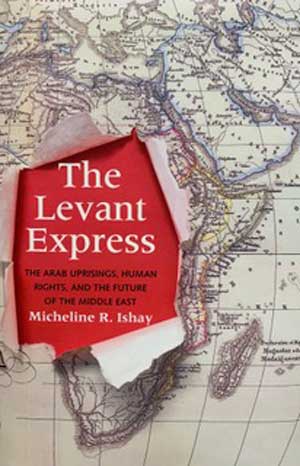
The Levant Express
Micheline R. Ishay The Levant Express: The Arab Uprisings, Human Rights, and the Future of the Middle East Yale University Press 352 pages, 6 1/8 x 9 1/4 inches ISBN 978 0300215694
Available here →February 19, 2020
20200219-ishay-micheline-on-book-levant-express-arab-uprisings-human-rights-3-1
A close-up
The rest of this thread

Micheline R. Ishay
Micheline Ishay is Distinguished Professor of International Studies and Human Rights at the Josef Korbel School of International Studies at the University of Denver, where she serves as Director of the International Human Rights Program. She is an affiliate faculty member with the Center for Middle East Studies and in 2008 was named University of Denver Distinguished Scholar. She has held visiting professorships at Hebrew University, Jerusalem and Khalifa University, Abu Dhabi, United Arab Emirates, along with fellowships at the University of Maryland and the Bellagio Center (Rockefeller Foundation) in Italy.
Pull this thread
The Arab uprisings follow a familiar pattern of revolution and counterrevolution, not a regional exception.
Know something the rest of us don't?
Most threads on Rorotoko begin with our invitation. Any thread can begin with a proposal: you write it with the same prompts every thread answers, and we review it.
Propose a thread →