
Mona L. Siegel
Peace on Our Terms
Nobody truly trains to be a global historian. The field is too vast; the subject matter is impossible to master. I came to this project as a historian of European feminism, pacifism, and internationalism. The history I studied pushed me to broaden my lens and recognize the global nature of women’s fight for equality and justice.
The first organization I studied was the Women’s International League for Peace and Freedom (WILPF). This amazing League—which continues to exist today—was born out of the fires and devastation of the First World War. It grew from the belief that in order for a peaceful world to flourish, women must collaborate fully in its construction. Decades ago, I read with astonishment of the WILPF’s efforts to intervene at the Paris Peace Conference of 1919. I applauded the determination of these pacifist women to put an end to hunger blockades and punitive peace terms, and I marveled at the skill of early League president, Jane Addams, in reconciling women so recently divided by bitter enemy lines.
At the time of this discovery, I assumed that the WILPF Congress of 1919 was a unique attempt by women to intervene in the peace negotiations. This assumption was confirmed by pretty much every history book ever written about the Paris Peace Conference. One scholarly tome after another either ignored women completely or reduced their interventions down to a brief passage or footnote.
Imagine my surprise, then, years later, when I stumbled across a reference to Chinese feminist Soumay Tcheng. Tcheng served as an interpreter to a WILPF delegation that traveled to Asia in the 1920s. The European WILPF members frequently described Tcheng as the first modern woman in China. Curious, I began poking around. Eventually I uncovered Tcheng’s English-language memoir, now out of print and published under her married name, Madame Wei Tao Ming. In the book, Tcheng describes her audacious efforts to secure national sovereignty while serving as an official Chinese delegate to the Paris Peace Conference.
How had I never seen a reference to Tcheng before? And if both Soumay Tcheng and delegates from the WILPF were in Paris in 1919 seeking to participate in the peace negotiations, were there other women who had done the same? My book grew from these questions. It asks: How did female activists from widely different backgrounds seek to contribute to peacemaking and international statecraft at the end of World War I? How did women reconcile competing loyalties to their sex, class, race, religion, and nation as they asserted their voices on the international stage, often for the first time? In what ways did gendered understandings of rights and politics influence their activism? And how did male elites work to contain feminism and defend politics and foreign affairs as a male domain into the postwar world?
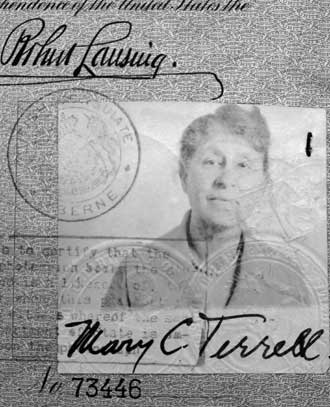
Mary Church Terrell Mary Church Terrell Papers, Library of Congress, Manuscript Division
Editor: Judi Pajo

Peace on Our Terms
Mona Siegel Peace on Our Terms: The Global Battle for Women's Rights After the First World War Columbia University Press 344 pages, 6.2 x 9.2 inches ISBN 978 0231195102
Available here →March 11, 2020
20200311-siegel-mona-on-book-peace-our-terms-global-battle-womens-rights-2-1
The wide angle
The rest of this thread

Maha Aldoori
Mona L. Siegel
Mona L. Siegel is a professor of history at California State University, Sacramento. Her first book, The Moral Disarmament of France: Education, Pacifism, and Patriotism, 1914-1940 (Cambridge University Press, 2004) was selected for the 2006 History of Education Society Outstanding Book Award. A recipient of two major grants from the National Endowment for the Humanities, Siegel has authored articles that have appeared in the Washington Post and the New York Times.
Pull this thread
The women's intervention at the 1919 peace was a simultaneous worldwide one, in Paris, Zurich, Washington, Cairo and Beijing.
Know something the rest of us don't?
Most threads on Rorotoko begin with our invitation. Any thread can begin with a proposal: you write it with the same prompts every thread answers, and we review it.
Propose a thread →