
Archie Brown
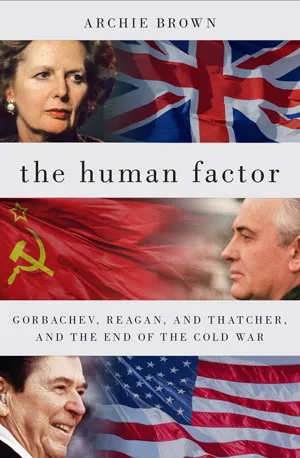
The Human Factor
How did your professional path lead you to this book?
I’ve always been interested in political leadership, both in democracies and in highly authoritarian systems. My earliest articles in academic journals—in the 1960s—were on the powers of the British prime minister and on the Soviet Union and Eastern Europe. The extreme centralization of power under Communism made the study of power and politics at the top of the hierarchy all the more important. Although I retained a serious interest in the politics of democracies, my main speciality became Communist politics. In the Cold War years, I made study visits to a number of Communist countries, including Czechoslovakia (as it then was), China, Hungary and Poland, and, more frequently, to the Soviet Union, including an entire academic year in Moscow State University in the 1960s (as a British Council exchange scholar).
I have a first-hand knowledge of the United States, the Soviet Union, and Great Britain—the three countries I am writing about in The Human Factor. I’ve spent most of my life in Britain, including the last fifty years in Oxford, where I was Professor of Politics (now Emeritus), but I also spent semesters or a whole academic year as a Visiting Professor in the United States (Yale, the University of Connecticut, Columbia, and the University of Texas in Austin) during the Cold War years.
Because of my speciality in the study of Communist politics, I had direct contact with party intellectuals who became influential during the perestroika years. I enjoyed friendly relations, for example, with Fedor Burlatsky, a political analyst who in pre-perestroika times was skilled at pushing official tolerance to its outer limits and in using Aesopian language to criticize the Soviet system. Burlatsky was at various times a consultant within the party’s Central Committee, a journalist on Pravda, a professor, a newspaper editor, a playwright, and a member of the new Soviet legislature elected in 1989. I knew Georgy Shakhnazarov, a closet social democrat in the pre-perestroika years, though he was the deputy head of a department of the Central Committee of the Communist Party.
He combined office as a high-ranking official with the Presidency of the Soviet Association of Political Sciences. In the second half of the 1980s, Shakhnazarov (whose son is a well-known Russian film director) became an aide to Gorbachev and his most influential adviser on political reform.
Significantly, on my first study visit to Prague in 1965, I got to know Zdeněk Mlynář, an academic lawyer who became a leading figure in the ‘Prague Spring’ of 1968. After the Soviet invasion in August of that year put an end to this reform movement in Czechoslovakia, Mlynář was expelled from the Communist Party and, from 1977, lived in Austria as a political exile.
In 1979, in conversation with him, I learned that his closest friend when he was a law student in Moscow University between 1950 and 1955 was none other than Mikhail Gorbachev, who the previous year had become the youngest member of the top leadership team in Moscow. Knowing Zdeněk Mlynář not only helped my understanding of political change in Czechoslovakia but in the Soviet Union as well.
I was already interested in Gorbachev. His comparative youth marked him out from the others within the ageing Soviet oligarchy led by Leonid Brezhnev. I asked Mlynář whether he thought Gorbachev had an open mind, and got the answer, “Yes, he’s open-minded, intelligent, and anti-Stalinist”.
To possess all three of those attributes, especially the first, distinguished Gorbachev from his colleagues in ways even more important than the generational difference. Mlynář was careful not to go public on his knowledge of Gorbachev until after his friend became Soviet leader in March 1985.
But he had shared some of this knowledge with me and, though I also protected my source (not quoting Mlynář by name), that was helpful when I took part in several seminars with Prime Minister Margaret Thatcher between 1983 and 1987.
It was in a paper I wrote for a seminar held at the prime minister’s country residence, Chequers, in September 1983, and in my oral presentation at that seminar, that she first heard of Gorbachev. I was one of eight academic participants. The seminar is described in the now declassified Cabinet Office and Foreign Office documents from that time as having led to a change of British foreign policy—to one of engagement with the Soviet Union and the Communist states of Eastern Europe.
The 1983 Chequers seminar was the beginning of a process that led to an invitation being sent to Gorbachev the following year to pay an official visit to Britain.
The night before he arrived in December 1984, I was one of several academics plus a businessman invited to a small and informal seminar at 10 Downing Street with Prime Minister Thatcher and Foreign Secretary Geoffrey Howe, in my case specifically to speak about Gorbachev.
It was only after he was out of power that I personally got to know Gorbachev himself (as distinct from studying him), but I’ve met him on quite a number of occasions and have taken part in seminars and conferences he chaired, both on perestroika and on the end of the Cold War.
Although I’ve read widely on Reagan and the Reagan presidency, I assumed that, of the three leaders who are the central characters in my recent book, he was the only one with whom I did not have even the most tenuous personal link. But as recently as 2020, I learned that one of the documents he was given to read in preparation for his summit meeting with Gorbachev in Reykjavik in 1986 was a quite lengthy article titled ‘Change in the Soviet Union’ I published in the journal, Foreign Affairs, earlier that year. I didn’t come across that annotated document when I was doing research in the Reagan Presidential Library Archives in 2016. But last year one of the helpful archivists sent me the document electronically. I was intrigued to see which passages Reagan had underlined.
During the Reagan presidency, I took part, as a specialist on Communist political systems, in policy-related seminars in Washington, including an Inter-Agency meeting with officials, and I gave evidence to the House of Representatives Foreign Affairs Committee (as well as to the House of Commons Foreign Affairs Committee in Britain).
I’d like to ask you to expand on what you have just said about your personal encounters with Margaret Thatcher and Mikhail Gorbachev and what could be called your indirect communication with Ronald Reagan. First of all, on the Chequers seminar in 1983. That must have been an impressive event. What was Thatcher’s reaction when you spoke about Gorbachev? Do you write about this in the book?
I do write about that 8 September 1983 seminar in the book. It was one of three meetings on developments in the Soviet Union, chaired by Margaret Thatcher, in which I took part, and it was the most important of them. That was because, as I mentioned in my previous answer, it led to a change of policy—well documented in the now declassified government papers and attributed there to that seminar—to much greater contact, including political dialogue, with the Soviet Union and Communist Europe. When we (the eight ‘outside experts’, of whom I was one) were asked by the prime minister for policy recommendations, we said, “the more contacts the better, and at all levels—from dissidents to general secretaries”.My paper for the seminar was about how the Soviet political system worked, so what I said about Gorbachev was just a part of it.
However, the very much longer paper from the Foreign Office did not mention Gorbachev or any other possible future Soviet leaders at all. Thatcher, Howe, and the small group of senior ministers and officials who participated in the seminar read the eight papers from the academics in advance of that meeting (which lasted from 9 o’clock in the morning until 3 p.m. and continued with just the Prime Minister, Foreign Secretary, Defence Secretary, and key officials present after we, the outside specialists, departed). In my paper I wrote that Gorbachev was a likely future Soviet leader and that he was not only the youngest but also “the best-educated member of the Politburo and probably the most open-minded”. I added that he “might well be the most hopeful choice from the point of view both of Soviet citizens and the outside world”.After I had elaborated on those written remarks in a 10-minute oral presentation at the seminar, Mrs Thatcher turned to the Foreign Secretary Geoffrey Howe and said, “Should we not invite Mr Gorbachev to Britain?”.
That was a fleeting remark which did not get into the official note of the seminar. In fact, it would have been premature to invite Gorbachev and might have done him more harm than good. He was not yet number two in the Soviet system. That was Konstantin Chernenko. Yuri Andropov was still general secretary and Andrei Gromyko was Foreign Minister. However, the seminar helped to lodge Gorbachev in Thatcher’s mind. Later that month (still September 1983) she asked Canadian Prime Minister Pierre Trudeau about him. Gorbachev, in his capacity as the Secretary of the Central Committee responsible for agriculture, had visited Canada earlier that year and had met with Trudeau.
After the death of Andropov in early 1984 and the choice of Chernenko to succeed him as Soviet leader, Gorbachev duly became number two in the Soviet hierarchy, although some in the old guard tried to prevent this. One largely formal role which went along with the position of second Secretary of the Central Committee was that of Chairman of the Foreign Affairs Committee of the Supreme Soviet (the rubber-stamp Soviet legislature). The British government was able to invite Gorbachev, in the latter capacity, to lead an ‘inter-parliamentary delegation’ to the UK. The invitation was sent in June 1984 and (as I mentioned earlier), Gorbachev came with his wife in December of that year. The group he led included Alexander Yakovlev, an influential adviser and ally, whom Gorbachev promoted at great speed once he became general secretary.
You met Gorbachev personally after he left office. What would you say about the after-office life of ‘the human factor’? Do leaders out-of-office continue to influence international relations?
I’ve met Mikhail Gorbachev about ten times, starting in 1993, when I made the introductory speech (not that he needed much introduction) before he spoke in Oxford Town Hall. Subsequent occasions included my speaking at several conferences he chaired in Moscow and Turin and being at his 70th, 75th, and 80th birthday celebrations.
It is impossible to measure how much influence a former leader wields or can wield. Gorbachev has not, unfortunately, had much impact in post-Soviet Russia. Both Yeltsin and Putin for different reasons have preferred to marginalise him. In the contemporary Russian mass media it is a bit easier to praise Stalin than to praise Gorbachev.
Nevertheless, the censorship is not as comprehensive as it was in the pre-perestroika Soviet Union and some appreciative articles have been published in small-circulation papers and online journals. There is a minority of Russians who still have the highest regard for Gorbachev and value highly what he did to introduce a whole range of freedoms they had not enjoyed before and his laying the foundations of Russian democracy which have, however, not been built on in subsequent years. Some of the freedoms he initiated, including the freedom to travel, still continue, but others have been greatly attenuated.
I would say that Gorbachev has continued to have some influence on international opinion through his speeches around the world (which continued until very recent years), books, articles, and interviews. Probably, though, he has not had much impact on Western office-holders. They have to deal with their counterpart in the Kremlin, whoever that person may be.
But Gorbachev, who was well ahead of most political leaders in the 1980s in taking ‘green’ issues seriously, has never stopped speaking out on his ecological concerns and on the dangers of scrapping arms reduction and arms control agreements. These included not only those which Gorbachev signed with Reagan and with Bush the elder, but even the ABM Treaty which put limits on the development of anti-ballistic missile systems. That Treaty was signed as long ago as 1972, but the United States withdrew from it in 2002, during the presidency of George W. Bush.
As recently as December 4th, 2018, Gorbachev and former US Secretary of State George Shultz (who died in February aged 100) published a joint article in the Washington Post warning of the dangers of abandoning the INF Treaty, signed by Gorbachev and Reagan in Washington in 1987.
As Gorbachev and Shultz wrote in the Post, this eliminated an “entire class of nuclear missiles” and “opened the way to a process of real nuclear disarmament”. Respected international elder statesmen—a category which included Shultz as well as Gorbachev—can have some influence on the climate of political debate. But when we examine the actual policy choices made by their successors in government, there is not much evidence of their arguments having any real impact where it would make the biggest difference.
Would you like to elaborate on any passages in your article that President Reagan highlighted?
I wouldn’t claim for a moment that Reagan remembered my article for long after he read it as part of his preparation for the summit meeting with Gorbachev in Reykjavik in October 1986. He was getting a lot of good advice in advance of his summit meetings, especially from Jack Matlock, the Soviet specialist on the National Security Council who became, from 1987 to 1991, US ambassador in Moscow.
But it was interesting for me to see which points in my 1986 Foreign Affairs article Reagan marked as of particular interest. They were, I would say, among the most salient points. I’ll give three examples. He put treble or double lines in the margin where I mentioned the scale of personnel change in Gorbachev’s first year as Soviet leader—when I wrote that no Soviet leader “in his first year of office has presided over such sweeping changes in the composition of the highest party and state organs as has Mikhail Gorbachev”, and a couple of pages later where I had observed that “Gorbachev’s appointments show imagination and indicate his desire to bring fresh minds to bear on problems and to break up cozy relationships in Moscow”.
The second example I’ll mention is his underlining my remark that “Gorbachev is sometimes described misleadingly as a technocrat” but, in reality, “he is a politician to his fingertips”. Those last words were marked by Reagan. The point I am making is of more substance than it may appear, because there was a tendency among Western officials, including diplomats, to think that, within the leadership group in a Communist system, technocrats always constituted the lesser evil. A contrast was made between them and ideologues. But it was people interested in ideas (who were neither technocrats nor rigid ideologues) who made the radical changes, whether in the ‘Prague Spring’ of 1968 or the Soviet perestroika. The sad truth is that you can always find technocrats who will serve any regime, no matter how authoritarian or nasty. When Western leaders met Gorbachev, they soon realized they were talking with a high-calibre fellow-politician, not a technocrat or, for that matter, a bureaucrat. ‘Politician’ should not be a pejorative term. The alternative to politicians is dictatorship.
The third example worth mentioning is Reagan’s highlighting the final sentence of my article which read: “Though the fate of Gorbachev’s policy innovation will be determined essentially within the Soviet Union itself, it requires something more from the West than the stock response”.
That was intended to be a warning that there were strict limits to Western influence on Russia, along with a call for some ‘New Thinking’ on the Western, as well as Soviet, side. Both parts of the sentence seem to have made sense to Reagan.
If a “just browsing” reader were to approach your book at a bookstore, which pages would you hope were encountered first—and why?
I can answer that one more briefly—the Introduction. It’s only four and a half pages in length (pp. 1-5), but it tells the reader what questions the book seeks to answer, and it notes that the story of the interconnections of Gorbachev, Reagan, and Thatcher “is a contribution not only to an explanation of the end of the Cold War but also to a much older debate on the role an individual may play in the making of history”.
The rest of the book is a mixture of political biography of the three central figures, an account of their interrelationship, a narrative of the process by which the Cold War was ended, and an explanation of why it ended when it did. On that last important theme of the book, it would be quite good if the casual reader browsed pages 297-298.
What would you wish a reader to take away from your book?
I would hope that people would see that Western triumphalist accounts of the Cold War’s ending, in which American military and economic strength forced the Soviet Union, in effect, to run up the white flag, are wrong. That interpretation is not only highly misleading, it’s very dangerous. The idea that superior armed force can secure the desired political change has underpinned several military interventions in the post-Cold War era which have made a bad situation worse. It has also led to the abandonment of important arms control and arms reduction agreements signed by Gorbachev, along with Presidents Reagan and Bush.
There was one sense in which the end of the Cold War was a victory for the West. Not only in Eastern Europe but crucially in the Soviet Union as well, there was support for freedom and democracy and an end to one-party dictatorship.
That policy was not forced on the Soviet leadership. Behind the monolithic façade that the Communist Party of the Soviet Union presented to their own people and the outside world, there was actually a wide diversity of views. Gorbachev himself evolved within a few short years from Communist reformer to democratizing transformer. The fact that he embraced ideas of freedom and democracy, very much in the way these notions were understood in the West, made possible their implementation in the Soviet Union and, with still greater alacrity, in Eastern Europe.
There was nothing inevitable about that, as the backsliding from democracy in the years since then makes clear. But ideas mattered, individual leaders mattered, dialogue and engagement mattered.
Reagan’s arms build-up came close to making the Cold War’s ending less rather than more likely. Until Gorbachev became Soviet leader, the Politburo response was to continue to build up its own military capacity and to strengthen political discipline at home and throughout the Warsaw Pact. The former long-serving Soviet ambassador to Washington, Anatoly Dobrynin, was just one of many senior officials to point out that Reagan’s first-term policies, including his Strategic Defense Initiative, and his rhetoric of those years, strengthened Soviet hard-liners in the internal Communist Party struggle. In March 1983, he launched SDI, a programme of research and development of anti-missile defence and, in the same month, described the Soviet Union as an ‘evil empire’.
During Reagan’s eight years as president, four different leaders were his Soviet counterparts—Leonid Brezhnev (whose last two years coincided with Reagan’s first two), Yuri Andropov, Konstantin Chernenko, and Mikhail Gorbachev. As Reagan understandably complained, “These guys keep dying on me”. Of the four, only Gorbachev survived Reagan. (His ninetieth birthday fell on March 2nd this year.) And it was only after Gorbachev came to power that East-West relations began to improve—within a few years dramatically so.
Reagan, during his second term, played an essential part in this, and Margaret Thatcher was an active intermediary, but I think a fair-minded reader of my book would reach the conclusion that Gorbachev was the most crucially important leader of the three.
I hope, too, that such a reader would realize the importance of dialogue and engagement with countries of different systems and ideologies. This has relevance for contemporary politics. There should be a distinction between principled criticism of other countries and demonizing them.
It is worth remembering that the end of the Cold War was a victory for both sides, and the only sense in which the West ‘won’ was in the realm of ideas. The principles and practice of democracy proved more attractive than Leninism, censorship, and one-party Communist rule. The power of political example was more important than the example of military power. The Soviet Union found it much easier to keep up militarily than to match the attraction of Western freedoms and democratic elections. In the end, a substantial section of the ruling party, including a leader unlike any previous Soviet leader, themselves embraced ideas which held sway in democracies worldwide.
But today we have moved far from the too easy assumptions at the end of the 1980s that there was something both preordained and lasting about democracy’s triumph. It is not only that Russia is substantially more authoritarian at present than it was in the last years of the Soviet Union (though less authoritarian than was the Soviet system pre-Gorbachev). It is also that we are living in a time when an American president has just refused to recognize the result of a democratic election which he comprehensively lost.
“
Understanding what went right during the years in which Soviet domestic and foreign policy were transformed—and how and why it went right—may provide”, I wrote in the conclusion to my book, “useful insight into what has gone wrong since”. I would hope that the book’s readers will find themselves drawing lessons for the here-and-now as well as learning more about an exceptionally important period in the recent past.
Editor's note: Originally, this interview ran on two days: the first four questions on March 31, and the other four questions on April 1, 2021.

Archie Brown speaking at a conference in the Gorbachev Foundation in Moscow in March 2010. The others in the photo are Mikhail Gorbachev who was chairing the session and (between him and the author) Alexander Bessmertnykh who was Soviet Foreign Minister in 1991, following the resignation of Eduard Shevardnadze.
Editor: Judi Pajo
The Human Factor
Archie Brown The Human Factor: Gorbachev, Reagan, and Thatcher, and the End of the Cold War Oxford University Press 512 pages, 6 1/8 x 9 1/4 inches ISBN 978 0190614898
Available here →March 31, 2021
20210331-brown-archie-on-book-human-factor-gorbachev-reagan-thatcher-end-3-1
A close-up
The rest of this thread
.webp)
Archie Brown
Archie Brown is Emeritus Professor of Politics, University of Oxford, and an Emeritus Fellow of St Antony’s College, Oxford. A Fellow of the British Academy since 1991 and an Honorary Foreign Member of the American Academy of Arts and Sciences since 2003, he is the author of numerous books and articles. They include The Gorbachev Factor, 1996; Seven Years that Changed the World: Perestroika in Perspective, 2007, The Rise and Fall of Communism, 2009; and The Myth of the Strong Leader: Political Leadership in the Modern Age, 2014, chosen by Bill Gates as one of the best four books he read in 2016.
Pull this thread
New ideas and leaders, Gorbachev above all, ended the Cold War, and the Soviet Union was never forced to yield.
Know something the rest of us don't?
Most threads on Rorotoko begin with our invitation. Any thread can begin with a proposal: you write it with the same prompts every thread answers, and we review it.
Propose a thread →