
Kiran K. Patel
Project Europe
Project Europe offers a radically different interpretation of the European Union’s history. It shifts the focus away from the motives and driving forces of European integration to the concrete effects and results for the lives of people in the member states and beyond. In doing so, it challenges and deconstructs the myths surrounding the establishment and evolution of the European Community (EC) as the predecessors of today’s EU.
Project Europe also assesses the various forms of criticism the EU frequently finds itself confronted with. The book covers the period from the first institutional attempts to build Europe in the second half of the 1940s until the end of the Cold War. It also discusses the lessons we can learn from this past for debates about the EU today.
In order to understand today’s EU, we need to revisit its history.
Project Europe explains why a rather narrow organization that initially comprised just six Western European states is today so frequently equated with Europe as a whole. There was no single blueprint behind this process, but a complex web of different and often contradictory trends. European integration has fundamentally changed over the course of its history, and its undeniable importance today would have appeared improbable just a few decades ago.
Many of the aspects we project back onto the early years in fact only took shape much more recently. Particularly the period of turmoil during the 1970s and 1980s helped to promote the European Community into the central European project. Incrementally, a new institutional reality arose, that subsequently also transformed the political systems of its member states.
The EC was born with a focus on economic integration, and to this day, the EU cannot deny its economic DNA. This business-centered capitalist logic was one of the main reasons why the EC were able to become the dominant forum of international cooperation in Europe at the time. Seeing the world through an economic lens decisively shaped the EC and continues to do so today—for better and worse.
That said, the effects of European integration on people’s lives remained mostly indirect and rather limited until the 1990s and 2000s.
This explains why the relationship between citizens and the EC was often brittle. The results of European integration only became fully evident decades later, and this gap between decisions and effects explains many of the challenges and crises the EU has to deal with in our own times.
Editor: Judi Pajo
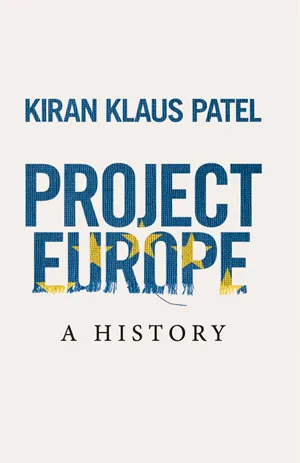
Project Europe
Kiran Klaus Patel Project Europe: A History Cambridge University Press 388 pages, 6 3/8 x 9 1/8 inches ISBN 978 1108494960
Available here →April 14, 2021
20210414-patel-kiran-on-book-project-europe-history-1-1-1
In a nutshell
The rest of this thread

Kiran K. Patel
Kiran Klaus Patel holds the chair of European history at Ludwig Maximilian University Munich. He also serves as the founding director of Project House Europe, LMU’s center for interdisciplinary research on the history of contemporary Europe. Before joining LMU, he held professorships at Maastricht University (2011-2019) and the European University Institute in Florence, Italy (2007-2011), and an assistant professorship at Humboldt University in Berlin (2002-2007). He has also been a visiting professor (inter alia) at the Ecole des Hautes Etudes en Sciences Sociales in Paris, the London School of Economics, and Sciences Po in Paris.
Pull this thread
For most of its history the European Community was a narrow economic organization with little direct effect on people's lives.
Know something the rest of us don't?
Most threads on Rorotoko begin with our invitation. Any thread can begin with a proposal: you write it with the same prompts every thread answers, and we review it.
Propose a thread →