
David Sulzer
Music, Math, and Mind
Perhaps the best way for a reader to begin is to peruse the questions that start each chapter and find ones that are of interest to them. The answers can be complicated—indeed some have been addressed throughout history—but no one should be intimidated. With some patience, the explanations are understandable by virtually anyone.Here is an example: most readers have heard of “brainwaves”, but likely have no idea of what this term really means.
In the chapter on brainwaves, we build on the previous chapter on rhythm in music, where we drew the conclusion that syncopation requires more than one “clock” of beats at a time, so we must have a means by which we can hold multiple clocks at once. To understand how this is accomplished, we relate how the cells of the brain communicate with each other through “synapses”. To do this, they modulate each other’s electrical currents, and we describe how the cells of the brain, the neurons, act as batteries. But what is a battery?
To understand that, we need to comprehend what voltage and current mean. We derive this using nothing more than multiplication and division by discussing how a bathtub fills with water from a water tower. (This last effort took me about two solid days to figure out for myself. But I explain it in two pages.)
From there we go through the history of the debate about whether animals produce electricity, which was partly settled by a study of the electric fish in the 1700s and later by experiments by Luigi Galvani, in which he stimulated a frog leg with electricity from lightning—a scientific paper published in 1791 that led to Mary Shelley’s book, Frankenstein.
From there, we discuss how a German doctor in 1929 recorded brain waves in humans by embedding recording electrodes under the scalps of his own children and discovered the alpha wave when he asked them to perform hard math problems, like dividing 196 by 7, in their heads.
We then discuss the nervous system rhythm with which we are most familiar, our heartbeat, and how the electrical currents that control the heartbeat are due to “channels” in the membrane that allow charged ions of sodium, potassium, and calcium to move back and forth inside and out from the cells. That allows us to move on to how the much faster rhythms in the central nervous system are activated by the same sorts of mechanisms.
Finally, we get to how the connections between these different neurons can lead to the production of rhythms in the brain, while acknowledging gaps in present knowledge on these questions. For listening material, we discuss the unnaturally rapid rhythms in electronic styles made on a laptop computer, Gene Wilder and Mel Brook’s Young Frankenstein, and the use of brainwaves to trigger music including my own record, The Brainwave Music Project, in which the computer musician Brad Garton and I enable jazz and classical performers to perform live duets with their own brain activity.
In order to disturb one’s own expectations and drive interruptions that cause a cortical phenomenon known as “auditory evoked potentials” I advise readers to listen to anything by Spike Jones and His City Slickers. Really, anything by them.In the Introduction, I write “no one needs this book”, as artists create great work without understanding the universal and physical bases of what they do. Yet artists and art lovers have imaginations that allow them to enter new territories and make the ones they already work in more profound.
This book will help them further appreciate their own nervous systems, the intelligence of other species, and the nature of the cosmos—this might seem over the top, but as readers will come to appreciate, a great deal of what humanity learned in these topics genuinely comes from the investigation of music.
As much as I hope that this learning will help creative readers develop new work, and help listeners develop their appreciation, I think that there are a series of profound lessons in how these investigations broaden our horizons and insights.
For example, there is a controversial hypothesis from Gordon Shaw’s “Mozart effect”, in which he theorized that children would be smarter if they listened and learned to play Mozart, and that this can be used in the treatment of childhood epilepsy. In some studies, the decrease in seizure activity lasted beyond the duration of the music, suggesting that such music may be therapeutic.
While the evidence is unclear, we have traced how sound and music travels to the cortex to modulate its synaptic activity, and in that way, playing a sound is analogous to a stimulating electrode in the deep brain. Our understanding of wave theory, which underlies all contemporary electronics, in part came from the development of the siren, as in a police siren, which was originally a musical instrument invented by a Scottish physicist, John Robison (1739-1805), and further improved by Charles de la Tour (1819), who named it for the mythical Greek singing legends.
The study of these soundwaves led to the discovery by Christian Doppler of the Doppler effect, which explains how siren pitches rise and fall. Albert Einstein extended Doppler’s insight in 1905 to describe how light travels at a constant velocity. The wavelength emitted from stars also stretches or compresses, and Edwin Hubble (1889-1953), extended this by noting that the most distant galaxies appeared red, suggesting that the “red shift” was due to the galaxies moving away from us, and so introduced the theory that we live in an expanding universe.
For the future, I suspect that some of humanity’s most important work will be in understanding other life. In this way, Roger Payne and colleague’s discovery of whale song, I think to some extent, helped to save them from extinction by our species. Recently, the primatologist Susan Savage-Rumbaugh with the musician Peter Gabriel showed that bonobos can improvise music, and Richard Lair and I showed the same with elephants. Perhaps the understanding of the art of other species will help us commit to treating them better and find ways by which they can survive the greed, thoughtlessness, and predation of our species.
And they will respond by lending insight into ourselves. Sue Savage-Rumbaugh, Itai Roffman, and others in their field are now writing convincing arguments that some of these species should be legally treated as human beings, with the same rights to survive and prosper. I suspect that the more we know, the more we will agree with them, and the richer our relationship with nature will be. In my opinion, this is the essence of spirituality and the most essential goal for all us. There is much to do…Art for all species!

The author with Richard Lair and the elephants and mahouts of the Thai Elephant Orchestra, the world’s heaviest improvising orchestra.
Editor: Judi Pajo

Music, Math, and Mind
David Sulzer Music, Math, and Mind: The Physics and Neuroscience of Music Columbia University Press304 pages, 6 x 9 inches ISBN 978 0231193795
Available here →April 21, 2021
20210421-sulzer-david-on-book-music-math-mind-physics-neuroscience-music-3-1
A close-up
The rest of this thread
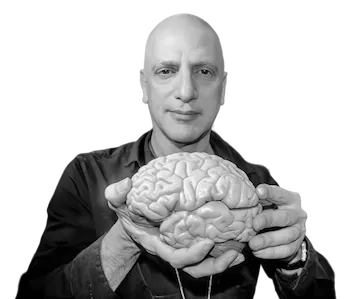
David Sulzer
David Sulzer, known in the musical world as Dave Soldier, is a professor of neuroscience at Columbia University, who leads a double life as a composer and performer.
Pull this thread
The physics and neuroscience behind every musical style can be taught with grade-school arithmetic, and conservatories teach none of it.
Know something the rest of us don't?
Most threads on Rorotoko begin with our invitation. Any thread can begin with a proposal: you write it with the same prompts every thread answers, and we review it.
Propose a thread →