
David Sulzer
Music, Math, and Mind
There are more styles of human music than there are human societies. But underlying all of them, even paleolithic styles, which can be deduced from surviving instruments in caves made from mammoth tusks, is an ancient and direct line of study that was initiated by natural philosophers in China, India, Egypt, and Greece. Their discoveries underpin the creation and comprehension of music, but are unknown to almost all musicians, as their training, understandably, has always been focused on learning the skills required to help earn a living.
But the questions of, for example, why there are musical scales, how instruments work, and the operation of the ear and auditory nervous system, underlie all music extending back to prehistory, and in many cases, throughout the animal kingdom. Indeed, one of the chapters is on music made and listened to by non-human animals. One surprising message is that the nervous systems of animals that seem very distant to us work very similarly to ours.
For example, the cortex of the ferret reacts specifically to different human spoken phonemes, such as the sound of “th” or “f”, although this can’t be an important aspect of their evolution. The brains of songbirds and frogs and some insects react very similarly to some features of music, such as consonance and dissonance, and they likely interpret some music in ways that are much closer to ours than we suspect.
On the other hand, some animals have extremely different sensory systems, and it is possible that the equivalent music or auditory communication in some moths are carried by the vibrations of leaves, a form of sound hard for us to imagine, or for some fish and bees, by electrical impulses, a sense that may be even more of a challenge to us to relate to.
While some of the topics covered on the book are very ancient (for example, the ways that we use rhythm and syncopation in music), some are extremely current and are undergoing rapid shifts.
This book covers essential questions; each chapter starts with these sorts of simple questions, and does its best to address them, and to outline what we do or do not know. At the end of each chapter is a listening section that outlines music that extends these discussions. Most of these listening examples will be unknown to most readers, even professional musicians. Some of the examples are from my own projects in both experimental science and art.
For example, in the Introduction, where I discuss issues of training or self-taught approaches to making music, I suggest records I produced of young children creating and performing their own pieces in Brooklyn, Conkary in Guinea (a remarkable school run by the jazz saxophonist Sylvain Leroux), the mountains of Guatemala, and New York’s Harlem, in addition to English children coached by one of the pioneers of electronic music, Daphne Oram.
In the chapter on the parameters of sound, I refer to recordings of the highest and lowest pitch singers and instruments, and my composition The Most Unwanted Song, written following a survey of the most disliked qualities in music. A chapter on the mathematics of rhythm refers to recordings of ancient Greek, ancient Arabic, flamenco, and Bach’s music, as well as my experiments with fractal canons. The chapter on animal music features many natural sounds, including the justifiably famous recordings of humpback whale songs and my construction of instruments for songbirds and for the Thai Elephant Orchestra, a group of 14 elephants in northern Thailand who have recorded 3 full length CDs.
Much of this book is based on a class I gave at Columbia University.
It is taken by a very wide range of students, including freshman, and art majors to engineering majors and medical students, even professors. I needed to find ways to explain these concepts to all of them. Notably, professionally trained musicians who have taken my class knew virtually none of the material: it simply is not taught in conservatories and art and music programs. This knowledge might however deepen their creative possibilities and the understanding of artists and art lovers.

The author with Richard Lair and the elephants and mahouts of the Thai Elephant Orchestra, the world’s heaviest improvising orchestra.
Editor: Judi Pajo

Music, Math, and Mind
David Sulzer Music, Math, and Mind: The Physics and Neuroscience of Music Columbia University Press 304 pages, 6 x 9 inches ISBN 978 0231193795
Available here →April 21, 2021
20210421-sulzer-david-on-book-music-math-mind-physics-neuroscience-music-2-1
The wide angle
The rest of this thread
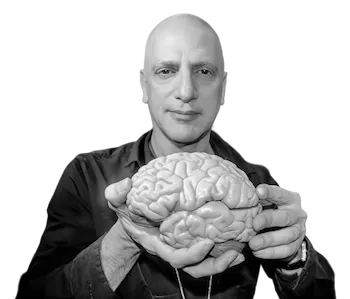
David Sulzer
David Sulzer, known in the musical world as Dave Soldier, is a professor of neuroscience at Columbia University, who leads a double life as a composer and performer.
Pull this thread
pulls againstpulls alongside
The physics and neuroscience behind every musical style can be taught with grade-school arithmetic, and conservatories teach none of it.
Against GS · Reason and language are irrelevant to moral status, so killing and eating animals is unjustifiable. On: There is a difference in kind, not merely of degree, between human minds and animal minds
Against KO · The philosophers who insist most on the man/animal divide depend most heavily on animals for their arguments. On: What we owe an animal follows from its capacities rather than from our relationship to it
Against JG · Story is what most sets humans apart, and fiction survived evolution because stories are flight simulators for social life. On: There is a difference in kind, not merely of degree, between human minds and animal minds
Against CP · We owe wild animals in distress nothing, and special care to the animals we bred into dependence. On: What we owe an animal follows from its capacities rather than from our relationship to it
Against ET · Gods were an incidental byproduct of brain evolution, born when autobiographical memory taught humans they would die. On: There is a difference in kind, not merely of degree, between human minds and animal minds
Alongside PL · Neanderthals could not produce the vowels that make speech clear, yet they talked, so language was no sudden human event. On: There is a difference in kind, not merely of degree, between human minds and animal minds
Alongside GF · No amount of humane handling justifies using animals at all, and veganism is the floor. On: What we owe an animal follows from its capacities rather than from our relationship to it
Alongside AM · The traits we treat as definingly human are shared with birds, especially parrots and corvids. On: There is a difference in kind, not merely of degree, between human minds and animal minds
Know something the rest of us don't?
Most threads on Rorotoko begin with our invitation. Any thread can begin with a proposal: you write it with the same prompts every thread answers, and we read it.
Propose a thread →