
Scott Peeples
The Man of the Crowd
At an American Literature conference about eight years ago, I presented a paper with the title “No Place Like Home”, which proposed that what the field of Poe biography had overlooked was the fact of Poe’s itinerancy. Poe changed addresses on average about once a year throughout his life. It’s not that we didn’t know this, but I don’t think Poe scholars or biographers had really thought much about what it means—how moving from house to house, city to city, might be a defining feature of his life. When I wrote that paper, I felt like I had the beginning of a new kind of Poe biography. “No Place Like Home” became the title of the book’s introduction, and the idea of being on the move became a strong motif alongside the central idea of the city.
The concept of place as explored by humanistic geographers has inspired a lot of work in literary studies over the past ten or twenty years. That scholarship usually involves questions about how meaning is constructed through place, both in literary works with a strong sense of location and in the lives of writers. Poe scholars have approached “place” in a variety of ways—fictional, symbolic places like the House of Usher or the torture chamber of “The Pit and Pendulum”, but also the question of Poe’s own sense of place and what it might mean for his fiction and poetry. This new wave of interest in place culminated in a collection of essays entitled Poe and Place, edited by Philip Phillips and published in 2018. I contributed an essay to that volume that in some ways previewed The Man of the Crowd; a discussion of Poe as a man on the move, and the difficulties of associating him too closely with any single place.
More broadly, I believe most Poe scholars see themselves as myth debunkers, because in popular culture Poe tends to be seen as a man who lived in a world of his own imagination, either on drugs or just intoxicated by his own misery and creativity. But there’s a lot of scholarship that emphasizes the various ways Poe was engaged with the social problems, the politics, the economics of the antebellum U.S., and I’ve drawn heavily on that scholarship in The Man of the Crowd. The book isn’t really a study in genius but more of a reality tour of Poe’s America.
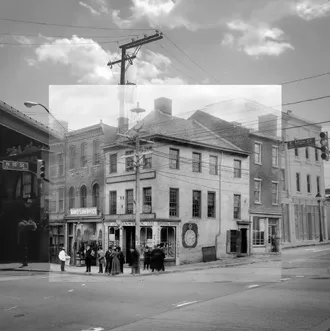
Archival photograph of the building that housed the Southern Literary Messenger, Poe’s workplace in Richmond from 1835 to early 1837, blended with a contemporary photograph of the same corner by Michelle Van Parys. Archival photograph courtesy of the Valentine, Richmond, VA.
Editor: Judi Pajo

The Man of the Crowd
Scott Peeples The Man of the Crowd: Edgar Allan Poe and the City Princeton University Press 224 pages, 5 1/2 x 8 1/2 inches ISBN 978 0691182407
Available here →May 12, 2021
20210512-peeples-scott-on-book-man-crowd-edgar-allan-poe-city-2-1
The wide angle
The rest of this thread

Michelle Van Parys
Scott Peeples
Scott Peeples is Professor of English at the College of Charleston, where he teaches courses in nineteenth-century American literature, Gothicism, and writing. The Man of the Crowd is his third book on Edgar Allan Poe; he also co-edited, with J. Gerald Kennedy, The Oxford Handbook of Edgar Allan Poe (2019). His essays on American literature have appeared in a wide range of publications, including Southern Cultures, J19, ESQ, Leviathan, and Salon.
Pull this thread
Poe's career is inseparable from the rapid growth of American cities.
Know something the rest of us don't?
Most threads on Rorotoko begin with our invitation. Any thread can begin with a proposal: you write it with the same prompts every thread answers, and we review it.
Propose a thread →