
Marni Reva Kessler
Discomfort Food
If a reader picked up Discomfort Food at a bookstore—enticed, I hope, by the suggestive cover—I would be so pleased if they looked through the introduction “Beginnings,” where I establish the contours of my argument, and the epilogue “‘Ending with the Beginning,’” in which I return to the more personal aspect of the book’s central premise, that representations of food have the ability to embody and express significance not only for the artist who imagined the work in the first place, but also for the viewer who may look at it however many years later. But even more, inherent in the titles of both the introduction and the epilogue is the notion that my own beginnings—in my family of origin, as a graduate student, as an academic—are profoundly braided with the analysis and archival research that form the basis of the study and are, to my mind, central to the project’s texture and ultimately, to its realization.
If a browser could indulge me further and read the short section in chapter one titled “The Lure of the Painting,” they could see even more concretely exactly how my beginnings are woven into the book’s core. Here, I describe the particular and very personal pull of Manet’s Fish (Still Life) and in so doing, I take a risk by both arguing and demonstrating that intermingling the scholarly and archival with the deeply personal yields rich interpretive possibility. Defying the (largely unspoken, but nevertheless entrenched) notion that academic work should remain distinct from the private, I pursue some of the reasons why this canvas “simultaneously beckons and repulses me” and find that it, quite unexpectedly, brings me to certain of my own memories. My delight in the painting’s intensely visceral materiality is tinged, I find, with measures of revulsion, sorrow, mournfulness, and longing, and I trace those visceral responses to fishing as a girl in the Catskill Mountains, to a photograph of my grandfather that sat on my grandmother’s dresser, and to wistful thoughts of my mother cooking in our kitchen in Brooklyn. “For even images of as-yet-unprepared raw ingredients [in Manet’s painting],” I discover, “can bear the ineffable traces of the effable past.” The sense of loss and sorrow that undergirds my interpretation of Fish (Still Life), also has the effect of greatly enhancing it. This willingness to allow my own thoughts to unspool, to reach back to long-forgotten memories even as I comb the archives and plumb the depths of the surface of the painting, I claim, is what leads me to see the deep poignance of this scattered array of piscine creatures and a lemon that is the color of the sun. My own memories, my losses and my sorrows, in other words, also “illuminate my path.”
I hope that Discomfort Food will convince readers that representations of food—those created in late nineteenth-century France and otherwise—should not be relegated to the category still life. While I recognize the works’ connections to seventeenth-century Dutch and eighteenth-century French still life precedents, with this project I seek to amplify and deepen our understanding of images of things that we consume by demonstrating that they should instead be appreciated in more generous historical, archival, theoretical, material, and visceral ways. We might savor their many and multifaceted resonances as we would a fine meal, relished for the complexity and richness inherent in them.
If the theories of academic practice establish the armature of this study, my own history lies at its beating heart. I didn’t know this when I started out, but during the years in which I worked on the book, I came to understand more about why the pictures upon which I focus matter so much to me. Why, for example, the mullet in Manet’s painting seemed to be so melancholy; why his eel disturbed me enough to think that I couldn’t write about the image; and why that unbearably beautiful lemon and those clattery oysters lured me back to the painting, unfurling memories of my mother making stuffed clams in our kitchen in Brooklyn. And something of the wedge of raw meat on the ground beside the sorrowful man in Degas’s painting led me, however circuitously, to my family’s holiday dinner table, to the brisket that we have eaten for generations, simmered for hours in that particular heady fusion of onions and garlic and cranberries and raspberry preserves. Such memories drove me, whether I always realized it or not, to search for these images’ most expansive resonances and material depths. Braiding the strands of personal experience and scholarly analysis, melding them as one would the ingredients in a recipe, I hope my book demonstrates, enriches and makes more complex the quality of the proverbial final dish. For, images of food, like their analogues in our world, touch us deeply. They are decidedly evocative and always personal—for the artist then as for the viewer now—and their sensory and conceptual dimensions seemingly endless in ways both concrete and ineffable.
Finally, I hope that this book will appeal to a broad range of readers. Blending academic writing and research with evocative and suggestive prose, I took certain risks that I couldn’t have taken as a young assistant professor. It’s quite liberating to be able to do the kind of writing and research that gives me the most pleasure and that also makes the book accessible to a wide readership. We all eat, no matter who we are or where or when we live(d). I sincerely hope that Discomfort Food will contribute to the many and varied conversations about food and its instability, historically and today, and that in so doing, it might expand our understanding of representations of one of the most fundamental things that unites as human beings.
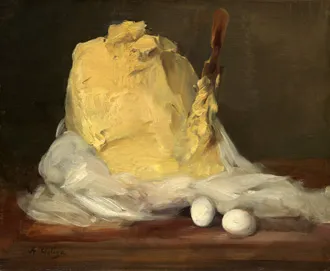
Antoine Vollon, Mound of Butter, 1875-85. Oil on canvas, 19.75 x 24 inches. National Gallery of Art, Washington D.C., Chester Dale Fund.
Editor: Judi Pajo

Discomfort Food
Marni Reva Kessler Discomfort Food: The Culinary Imagination in Late Nineteenth-Century French Art University of Minnesota Press 320 pages, 6 x 8 inches ISBN 978 1517908805
Available here →June 30, 2021
20210630-kessler-marni-on-book-discomfort-food-culinary-imagination-late-3-1
A close-up
The rest of this thread

Marni Reva Kessler
Marni Reva Kessler is Professor and Director of Graduate Studies in the Kress Foundation Department of Art History at the University of Kansas, where she teaches courses on 18th- and 19th-century European art and critical theory and methodology. In addition to Discomfort Food: The Culinary Imagination in Late Nineteenth-Century French Art, which is the focus of her Rorotoko interview, she is also the author of Sheer Presence: The Veil in Manet’s Paris (University of Minnesota Press, 2007) as well as book chapters and articles on topics related to portraiture, urbanism, photography, food, and fashion in the work of such artists as Manet, Degas, Caillebotte, Morisot, Monet, and Vuillard.
Pull this thread
Paintings of food are not still lifes, and Manet's fish conjure the corpses of the new Paris Morgue.
Know something the rest of us don't?
Most threads on Rorotoko begin with our invitation. Any thread can begin with a proposal: you write it with the same prompts every thread answers, and we review it.
Propose a thread →