
Marni Reva Kessler
Discomfort Food
In Discomfort Food, I argue that representations of food are profoundly evocative, able to convey material and immaterial possibilities that are inconsistent with their seemingly mundane subject matter. Depictions of the alimentary resonate far beyond the physical bounds of the picture plane, tying us to both the sensory present and the fullness of the past, to our memories, our families, our traditions, our happinesses, and our losses. And these works are, of course, fixed, too, to the artists who created them, to sentient beings who lived and ate, who loved and experienced sadness.
At the center of my study are works by Édouard Manet, Antoine Vollon, Gustave Caillebotte, and Edgar Degas that, for most, conjure unbroken narratives of gustatory pleasures. But, as I show, each of these works also engage more nuanced and even unsettling associations. These pictures of fish, fruit, butter, and meat, things so apparently anodyne, are, in my analysis, haunted by anxiety, nostalgia, and melancholy for and about family, home, and the past. Rooted in histories, these images immerse us, too, in the present, in the smell and taste and feel of what we see portrayed. Our visceral responses, I thus suggest, matter deeply to our experience of representations of food, and this sensitivity to their affective qualities helps us to construe their utter capaciousness, their tensions and contradictory effects, their abilities to signify across a spectrum of unalloyed beauty and base disgust. These pictures of things so quotidian and that we associate with a range of culinary pleasures, each in their own unique ways demonstrate, too, their own inherent displeasures.
In considering—along with the scholarly—such subjective nuances and how they might be articulated in depictions of food, I shift away from the prevailing tendency to categorize them simply as still lifes and toward more analytic scrutiny of them as representations containing tangible critical capacities and expressive force that we more readily associate with real food. With this project, I thus seek to augment our study of images of edible things by demonstrating that certain linear models and classifications fail to do justice to the ways in which they are singularly suggestive, engendering distinctly visceral reactions of the sort that we may have in relation to a painting of, say, flowers, insects, books, or shells. Depictions of food are deeply complex and individual. They inevitably summon not just some of the more fugitive aspects of everyday life but also the intricate webs that constitute our memories and the myriad pleasures and discomforts that may accompany our thoughts of them. They are always richly evocative, capable of conveying delight and the promise of culinary satisfaction even as they sublimate their corollary. By introducing the transgressive power of food into analysis of representations of it, I thus expose the profoundly personal and messier aspects of images that take as their subject something so fundamental to human experience.
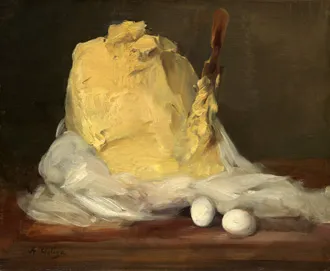
Antoine Vollon, Mound of Butter, 1875-85. Oil on canvas, 19.75 x 24 inches. National Gallery of Art, Washington D.C., Chester Dale Fund.
Editor: Judi Pajo

Discomfort Food
Marni Reva Kessler Discomfort Food: The Culinary Imagination in Late Nineteenth-Century French Art University of Minnesota Press 320 pages, 6 x 8 inches ISBN 978 1517908805
Available here →June 30, 2021
20210630-kessler-marni-on-book-discomfort-food-culinary-imagination-late-1-1-1
In a nutshell
The rest of this thread

Marni Reva Kessler
Marni Reva Kessler is Professor and Director of Graduate Studies in the Kress Foundation Department of Art History at the University of Kansas, where she teaches courses on 18th- and 19th-century European art and critical theory and methodology. In addition to Discomfort Food: The Culinary Imagination in Late Nineteenth-Century French Art, which is the focus of her Rorotoko interview, she is also the author of Sheer Presence: The Veil in Manet’s Paris (University of Minnesota Press, 2007) as well as book chapters and articles on topics related to portraiture, urbanism, photography, food, and fashion in the work of such artists as Manet, Degas, Caillebotte, Morisot, Monet, and Vuillard.
Pull this thread
Paintings of food are not still lifes.
Know something the rest of us don't?
Most threads on Rorotoko begin with our invitation. Any thread can begin with a proposal: you write it with the same prompts every thread answers, and we review it.
Propose a thread →