
David L. Sloss
Tyrants on Twitter
What does the battlefield in this information war look like? What weapons are being used on social media? Let me focus on social media, particularly, the Russian interference in the 2016 election in the United States, as an example. By way of background, the book documents the fact that Russia has interfered in democratic elections over the last decade or so in about 20 different countries, all of which are members of either NATO or the European Union, or both, so this is a pretty widespread phenomenon.
Russian interference in the US election in 2016 made extensive use of social media and, in particular, fake accounts on social media. In the book, I distinguish among about six or seven different types of fake accounts – that’s probably a novel contribution, breaking that down and analyzing the different types of fake accounts.
But without going into those kinds of details, essentially, what you get is Russian agents impersonating US citizens and setting up accounts on Facebook, Twitter, Instagram, etc., where they are pretending to be US citizens and engaging with other US citizens in conversations about the upcoming 2016 election. Interestingly, Yevgeny Prigozhin, who’s been in the news recently as the head of the Wagner group, was at that time the head of an entity called the Internet Research Agency, which was the primary Russian organization involved in setting up these fake accounts on social media for the purpose of conducting electoral interference.
Some of these Russian accounts got huge numbers of followers and were very influential – at least if you measure influence in terms of the number of likes and followers, and that sort of thing. Russian fake accounts reached a very broad audience, and for the most part the audience thought they were engaging with Americans. There is evidence that these agents were engaged with Donald Trump, Jr. He was happy to engage with these folks on social media, and he thought he was talking to Republican voters in the United States, when he was really talking to Russian agents.
There’s a plausible argument that Russian intervention was sufficiently influential to sway enough votes in the three key battleground states – Michigan, Pennsylvania, and Wisconsin – to swing the election in favor of Donald Trump. There’s no question they were trying to swing the election in favor of Donald Trump; that’s well documented in the Mueller Report. There is a lot of debate about how successful they were. Ultimately, that’s an unanswerable question. We don’t know. But it’s at least plausible that Russian agents may have been sufficiently influential to swing enough votes in those three states to make a difference in the electoral outcome. That, in itself, is pretty scary.
China is more in the camp of strengthening and promoting authoritarianism, rather than undermining democracy. The main countries where China is really undermining democracy are Taiwan, where they intervene very extensively, not surprisingly, and also Australia. Social media is one piece of a broader Chinese effort to subvert democracy in those places.
But in some ways what’s of greater concern is that China has effectively used information technology to create a surveillance state within China that is reminiscent of George Orwell’s 1984. Moreover, Chinese companies have exported that technology to countries all over the world. Dictators around the world are happy to scoop up that technology because it enables them to strengthen dictatorial control in their own countries.
There’s some very good empirical, social science evidence showing that dictators who import this kind of technology or make greater use of advanced information technology strengthen and lengthen their dictatorial control. The technology helps them remain in power longer because it enables them to strengthen their control over their populations.
One of the key arguments in the book is that information technology has created an uneven playing field. Not everybody is comfortable with the idea of a global struggle between democracy and authoritarianism. But I don’t think it’s wrong to look at the world that way. There are other ways you can look at it, but I think it’s reasonable to argue that the world is currently in the middle of a global struggle between democracy and authoritarianism. In that struggle, information technology tilts the playing field in favor of autocrats and against the democrats.
Therefore, the main goal of my proposed regulatory solution is to level the playing field. The proposal is not designed to end autocracy around the world. I don’t think that’s a reasonable goal. I think autocracy is going to be with us for a long time. But I do want to try and level the playing field in the political competition between democracies and autocracies. That is the central goal of my policy proposal.
Editor: Judi Pajo

Tyrants on Twitter
David L. Sloss Tyrants on Twitter: Protecting Democracies from Information Warfare Stanford University Press 352 pages, 6 1/2 x 9 1/4 inches ISBN 9781503628441
Available here →August 2, 2023
20230802-sloss-david-on-book-tyrants-twitter-protecting-democracies-from-information-warfare-2-1
The wide angle
The rest of this thread
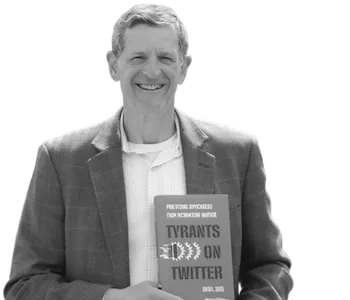
David L. Sloss
David L. Sloss is the John A. and Elizabeth H. Sutro Professor of Law at Santa Clara University. He has written two books and is the editor of three other books. He has published several dozen book chapters and law review articles. Three of his books have won prestigious awards. His scholarship is informed by extensive government experience. Before entering academia, he spent nine years in the federal government, where he worked on U.S.-Soviet arms control negotiations and nuclear proliferation issues.
Pull this thread
The fix for Chinese and Russian information warfare is a treaty banning their state agents from social media.
Know something the rest of us don't?
Most threads on Rorotoko begin with our invitation. Any thread can begin with a proposal: you write it with the same prompts every thread answers, and we review it.
Propose a thread →