
Mark Galeotti
The Weaponisation of Everything
Two aspects of my professional path led me to this book. I have been working on security studies, with a particular focus on Russia since before Russia was an independent state, in the days when the perceived threat came not from election interference or espionage so much as the Red Army rolling into western Europe. Over time, our whole notion of ‘security studies’ changed, and I changed with it, as the threat became more about banks than tanks, thugs than MiGs.
In that context, I also have a specific interest in Russian organised crime (which led to my 2018 book The Vory: Russia’s Super Mafia, and in particular its relationship with the Kremlin. Under Putin, we have seen the Russian state increasingly using organised crime as an instrument of statecraft, for everything from sanctions-busting to assassinations abroad. That got me thinking of the new ways nations can ‘fight’ and the new ‘soldiers’ they can use in the modern age, ones to which we often fail to pay enough attention.
After all, modern transnational organised crime, taking fullest advantages of the weaknesses in the modern world order, is a perfect example of the dark side of globalisation, something at the heart of this book. It was hoped that the more we are connected, the less likely wars will be, and to a degree that is true: now, we can easily find that potential enemies are also the people from whom we buy food or sell cars, take loans or license technology. The flipside, though, is that we become more vulnerable because of this interconnectedness. The war in Ukraine caused hunger in sub-Saharan Africa; a Chinese invasion of Taiwan would mean a crisis in the global microchip industry; a hacker in Argentina can collapse a bank in Zimbabwe. As a result, countries are both so much more vulnerable to interference from afar, but also have many more opportunities to interfere themselves.
After all, there is nothing new in the reality of countries meddling in, undermining and subverting others, and doing so often covertly. A recurring theme of the book is drawing on examples from the Renaissance, when European nations were beginning to be bound together more tightly by bonds of faith, finance and ideas.
What has changed is just how many things can be weaponised, and how quickly and easily. Thanks to cheap and easy air travel, for example, in 2021 Belarus could recruit would-be migrants from the Middle East eager to find new lives inside the European Union and try to force them across Poland’s border. Likewise, where once disinformation operations might have taken months or years to set up, with fake newspapers established and documents forged, now thanks to the internet they can be launched in hours or days.
Editor: Judi Pajo
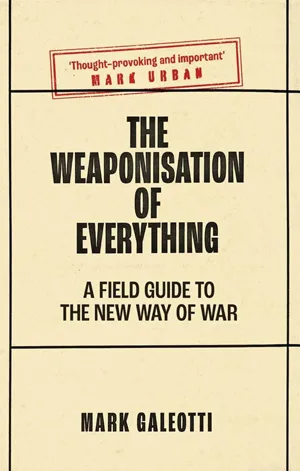
The Weaponisation of Everything
Mark Galeotti The Weaponisation of Everything: A Field Guide to the New Way of War Yale University Press 256 pages, 5 x 7 ¾ inches ISBN 978 0300270419
Available here →January 18, 2024
20240118-galeotti-mark-on-book-weaponisation-everything-field-guide-new-way-war-2-1
The wide angle
The rest of this thread

Mark Galeotti
Mark Galeotti is one of the world’s leading experts on Russian crime and security, which may explain why Moscow banned him in 2022. After reading history at Cambridge, he took his doctorate in politics at the LSE. After a stint with the British Foreign Office, he has been a scholar and think-tanker in London, New York, Moscow, Prague and Florence, and now heads the consultancy Mayak Intelligence and is an honorary professor at University College London. His next book is the co-authored Downfall: Prigozhin, Putin, and the New Fight for the Future of Russia (2024).
Pull this thread
Shooting war is becoming too expensive to wage, so conflict is migrating into law, trade, tourism, migration and crime.
Know something the rest of us don't?
Most threads on Rorotoko begin with our invitation. Any thread can begin with a proposal: you write it with the same prompts every thread answers, and we review it.
Propose a thread →