
Mark Galeotti
The Weaponisation of Everything
At the start of each chapter is a scenario illustrating the themes it is addressing, and while the first is a speculative near-future one (a Chinese operation to seize control of Japan’s electricity grid) and the last an historical one (a clash between mercenary armies outside Renaissance Florence), the others are all drawn from the modern world. China weaponising its tourist industry to punish the island nation of Palau for continuing to recognise Taiwan as an independent nation. Russia kidnapping an Estonian security officer to stop him from investigating cigarette smugglers who were also Moscow’s spies. The London insurance market being used to block weapons from being sent to Syria.
My hope is that these and all the other specific examples presented help ram home two points. First of all, that this is not some airy speculation about the day after tomorrow, but what is already happening all around us, and affects us whether we know it or not and like it or not. Secondly, as a way of helping people think about the world. At the risk of being accused of cultivating paranoia, I do genuinely believe that as citizens of democratic nations, we must come to terms with the world in which we live, and the under-the-radar threats we face.
Perversely, there is a part of me that hopes the book’s thesis will be proven wrong. Not the part about the increasingly cost-ineffective nature of modern war, but rather, of the way we are sliding into an age of constant, undeclared, non-military conflict of all against all.
Failing that, as I say above, at least I can hope to de-mystify the process—and also help people realise that there are opportunities as well as dangers in this new age of war. First of all, there are things we can do in order to reduce our vulnerabilities as individuals, nations and societies. Of course, there is always the danger that we learn the wrong lessons. We too often look for quick fixes, which are often of little or no value, or even counter-productive. Responding to the challenge of disinformation through setting up ‘fact checkers,’ for example, risks replacing one set of falsehoods with another. Everyone can have their own notion of what ‘fake news’ means.
The real answers are long-term: greater awareness of the new world of security challenges (so, for example, countries diversify their sources of energy, investment, food and strategic resources) and above all, resilience. This last means better public education so people are less vulnerable to disinformation, more transparency to reveal corruption and hostile strategic investment, more spending on intelligence and counterintelligence rather than just on tanks and jets, and generally a new 360-degree awareness of security that appreciates that non-military means can be just as powerful as military ones.
Is an aircraft carrier a better guarantor of real security than the equivalent amount spent on media literacy or public health or border policing? Can a hostile country be threatened more effectively by an internet campaign highlighting its rulers’ corruption and incompetence than by troop manoeuvres on their border? Is spending a hundred million dollars on aid to an impoverished country a good investment if it prevents hungry, angry people from turning to piracy? There are the kind of security dilemmas we need to be considering in the twenty-first century.
Editor: Judi Pajo
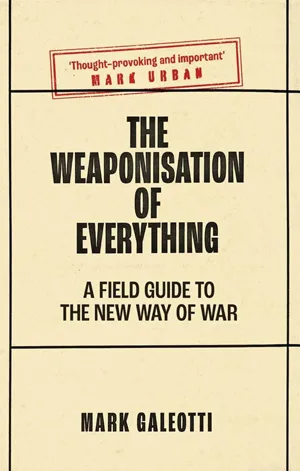
The Weaponisation of Everything
Mark Galeotti The Weaponisation of Everything: A Field Guide to the New Way of War Yale University Press 256 pages, 5 x 7 ¾ inches ISBN 978 0300270419
Available here →January 18, 2024
20240118-galeotti-mark-on-book-weaponisation-everything-field-guide-new-way-war-3-1
A close-up
The rest of this thread

Mark Galeotti
Mark Galeotti is one of the world’s leading experts on Russian crime and security, which may explain why Moscow banned him in 2022. After reading history at Cambridge, he took his doctorate in politics at the LSE. After a stint with the British Foreign Office, he has been a scholar and think-tanker in London, New York, Moscow, Prague and Florence, and now heads the consultancy Mayak Intelligence and is an honorary professor at University College London. His next book is the co-authored Downfall: Prigozhin, Putin, and the New Fight for the Future of Russia (2024).
Pull this thread
Shooting war is becoming too expensive to wage, so conflict is migrating into law, trade, tourism, migration and crime.
Know something the rest of us don't?
Most threads on Rorotoko begin with our invitation. Any thread can begin with a proposal: you write it with the same prompts every thread answers, and we review it.
Propose a thread →