
Claudia Calirman
Dissident Practices
The book is organized thematically in four chapters on different kinds of “dissident practices:” Political Practices, Discursive Practices, Transgressive Practices, and Practices of the Self. The selection of the artists was based on their diverse “practices of resistance,” a term coined by Michel Foucault to convey strategies to build new forms of living and resistance to power. These artists opposed normative policies, resisted authoritarianism, transgressed imposed boundaries, pushed back against female objectification, and challenged construction of “women” as a fixed category. Their works relate to crucial key political moments in Brazil’s history. These include the period of military dictatorship from the mid-60s to the mid-80s, the country’s re-democratization period of the mid to late 80s, its social struggles of the 90s, the ascent of the Worker’s Party in the first years of the 2000s, the return of the Right in Brazil in the mid-2010s, and the emergence of an “overtly feminist art” in the country since 2015. Dissident Practices is not about the history of feminism in Brazil but rather a narrative of a broader history of social resistance from the point of view of women artists.
Dissident Practices builds on my 2012 book Brazilian Art under Dictatorship: Antonio Manuel, Artur Barrio, and Cildo Meireles, which analyzes the intersection of the visual arts and politics during the most repressive years of Brazil’s military regime, the so-called anos de chumbo (leaden years) of 1968–75. Growing up in Rio de Janeiro under the military regime and later working as journalist, my inquisitive nature led me to learn more about this repressive period in Brazilian history. More recently, I became interested in exploring a vibrant generation of younger women artists who blossomed in Brazil. at the beginning of the twenty-first century, concomitantly with the “Me Too” movement.
Combining my academic background as an art historian and my professional experience as a journalist, I believe I was in a unique position to analyze the artistic production of this tumultuous six-decade period, from the rise of Brazil’s military dictatorship through the present. Major works by artists such as Anna Maria Maiolino, Lygia Pape, Anna Bella Geiger, Lyz Parayzo, Rosana Paulino, Renata Felinto, Sallisa Rosa, and Berna Reale, among others, are discussed through their anti-authoritarian and transgressive practices.
Editor: Judi Pajo
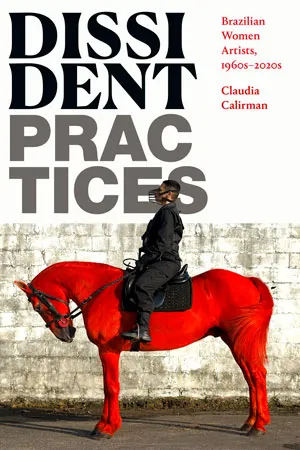
Dissident Practices
Claudia Calirman Dissident Practices: Brazilian Women Artists, 1960s–2020s Duke University Press 264 pages, 6 x 9 inches ISBN 978 1478016779
Available here →March 14, 2024
20240314-calirman-claudia-on-book-dissident-practices-brazilian-women-artists-1960s-2020s-2-1
The wide angle
The rest of this thread

Claudia Calirman
Claudia Calirman is the Chair and Professor of Art History in the Department of Art and Music at John Jay College of Criminal Justice, CUNY. She is the author of Dissident Practices: Brazilian Women Artists, 1960s-2020s (Duke, 2023). Calirman’s first book, Brazilian Art under Dictatorship: Antonio Manuel, Artur Barrio, and Cildo Meireles (Duke, 2012), analyzes the intersection of politics and the visual arts during the most repressive years of Brazil’s military regime. It received the Arvey Award by the Association for Latin American Art. Calirman is also a recipient of the Arts Writers Grant from Creative Capital/Warhol Foundation.
Pull this thread
Brazilian women artists under the military regime refused the word feminism as a US import while using feminist strategies.
Know something the rest of us don't?
Most threads on Rorotoko begin with our invitation. Any thread can begin with a proposal: you write it with the same prompts every thread answers, and we review it.
Propose a thread →