
Hanne Strager
If I Am Right, and I Know I Am
If I Am Right, and I Know I Am is the story of a woman who changed our understanding of the planet but never received the recognition she deserved. It is the first biography of Inge Lehmann, the Danish geophysicist who discovered Earth’s solid inner core in 1936.
I didn’t want to write a traditional scientific biography. I wanted to write a book that feels alive. A book that reads as easily as a good novel, while staying faithful to the science and the history. Lehmann lived a long life—104 years—and her inner world was as complex as the geophysical world she studied. She struggled with debilitating shyness, anxiety and selfdoubt. At times she isolated herself just to cope. She was also brilliant, stubborn, and deeply dedicated to her work.
The story of Inge Lemann’s life is a universal tale of an extraordinary woman’s struggle to find her footing in life and a path to thrive intellectually and personally in a society not yet ready to her way of being a woman. Born in 1888, Inge Lehmann grew up in the Victorian Era characterized by the doctrine of separate spheres, when men were men and women were wives, mothers, and housekeepers. Early on, Inge Lehmann aspired to more.
To understand what Inge Lehmann was up against and to fully appreciate the extent of her accomplishments the book places them within the context of the societal constraints on women’s life in the 19th ad 20th centuries. How were women expected to behave? What level of education was it appropriate for them to have and what kind of activities was suitable for young women (fiction reading and needlework is the correct answer). If they did play tennis or ride bikes, they should still wear corsets and ankle-length skirts. Women were not allowed to study at universities and when those rules eventually changed, they could not obtain degrees even when they passed the same exams as men. At that time doctors warned that studying would make women less feminine as it could lead to atrophy of their ovaries and other internal organs.
I want readers to meet a real person behind the scientific achievements. Someone who lived with mental burdens and yet managed to reshape a scientific field. I want readers to see that science does not happen in a vacuum. It happens in messy lives, in troubled minds, in moments of clarity that emerge sometimes after years of uncertainty.
If hope readers come away feeling that they truly met Inge Lehmann—and that her discovery matters even more because of what it cost her.
Curator: Rachel Althof
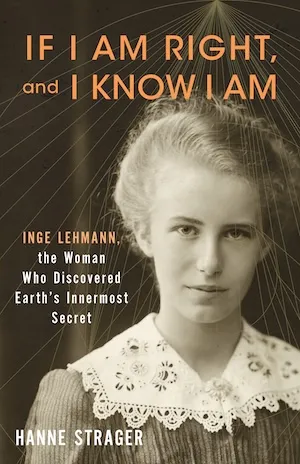
If I Am Right, and I Know I Am
Hanne Strager (2025) If I Am Right, and I Know I Am: Inge Lehmann, the Woman Who Discovered Earth’s Innermost Secret Columbia University Press 320 Pages, 6 x 9 inches, ISBN: 9780231562386
Available here →January 9, 2026
20250109-strager-hanne-inge-lehman-earth
In a nutshell
The rest of this thread

Hanne Strager
Hanne Strager is a Danish biologist and science writer. She holds a graduate degree from the University of Aarhus and was a Fulbright Scholar at the University of California, Santa Cruz. With more than 15 years of experience in science communication, she previously served as Director of Exhibitions and Education at the Natural History Museum of Denmark, where she received the University of Copenhagen Natural Sciences Faculty’s prize for science communication. Her books include The Killer Whale Journals: Our Love and Fear of Orcas (2023), winner of the National Outdoor Book Award. She is currently Director of Exhibitions at The Whale in Norway.
Pull this thread
Inge Lehmann discovered the Earth's solid inner core in 1936.
Know something the rest of us don't?
Most threads on Rorotoko begin with our invitation. Any thread can begin with a proposal: you write it with the same prompts every thread answers, and we review it.
Propose a thread →