
Hanne Strager
If I Am Right, and I Know I Am
More than a traditional biography this book takes on the form of a popular science exploration, inviting the readers on a journey through the changing landscape of Earth science. Interwoven with the story of Inge Lehmann’s achievements is the history of Earth Science which underwent a revolution during her long and eventful life.
These were the years were scientists discovered that Earth was not a solid rock all the way through, that molten lava came from the hot core of the Earth, that continents were not stock-still but moved around and formed new continents and that earthquakes occurred where continental plates collided. These important milestones in Earth Science form a coherent story of how our understanding of our own planet has changed and they are told in separate short chapters all with a connection to Inge Lehmann’s life and following the chronology of her biography.
Many of her colleagues also made important contributions, and the stories of these trailblazing—and sometimes quite eccentric—scientists are woven throughout the book, along with anecdotes about their lives and discoveries. They were enormously influential and pursued their scientific quests for truth with great determination, sometimes even dying in the process. Among others the readers will meet the German scientist Alfred Wegener who proposed the theory of continental drift (and was ridiculed for it), Inge Lehmann’s close friend Harold Jeffreys, from Cambridge in England, who argued that Earth has a fluid inner core (and was proven wrong by Inge Lehmann) and the American geologist Marie Tharp, who worked next to Inge Lehmann at Columbia University and found crucial evidence that ultimately contributed to the hypothesis of plate tectonics.
My path to the book began in a very ordinary moment. I was working at the Natural History Museum of Denmark. One of the geologists at the museum mentioned Lehmann to me in passing. He spoke of her with deep respect. He assumed I knew who she was. But I had never heard of her—not in school, not in university, not anywhere. That surprised me. And it bothered me. How could a woman who discovered something so fundamental be so invisible?
That was the spark.
When I opened the archives and read her letters, I felt a sense of responsibility. Here was a story that had slipped out of history, a story that needed to be told. I found a life shaped by brilliance and by hardship. A life marked by scientific courage and by emotional vulnerability.
Writing this book became my way of giving her a place in the story of how we came to understand our own planet.
Curator: Rachel Althof
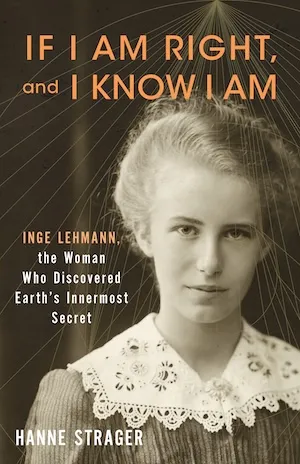
If I Am Right, and I Know I Am
Hanne Strager (2025) If I Am Right, and I Know I Am: Inge Lehmann, the Woman Who Discovered Earth’s Innermost Secret Columbia University Press 320 Pages, 6 x 9 inches, ISBN: 9780231562386
Available here →January 26, 2026
20250128-strager-hanne-inge-lehman-earth
The wide angle
The rest of this thread

Hanne Strager
Hanne Strager is a Danish biologist and science writer. She holds a graduate degree from the University of Aarhus and was a Fulbright Scholar at the University of California, Santa Cruz. With more than 15 years of experience in science communication, she previously served as Director of Exhibitions and Education at the Natural History Museum of Denmark, where she received the University of Copenhagen Natural Sciences Faculty’s prize for science communication. Her books include The Killer Whale Journals: Our Love and Fear of Orcas (2023), winner of the National Outdoor Book Award. She is currently Director of Exhibitions at The Whale in Norway.
Pull this thread
Inge Lehmann discovered the Earth's solid inner core in 1936, and her achievement is larger for what it cost her.
Know something the rest of us don't?
Most threads on Rorotoko begin with our invitation. Any thread can begin with a proposal: you write it with the same prompts every thread answers, and we review it.
Propose a thread →