
Jonathan P. Lamb
How the World Became a Book in Shakespeare's England
I hope readers look first at the table of contents, to see the whole range of topics covered in the book: from printing language to book-related insults, and from scientific claims to racial categorization. I hope readers would begin reading with the Preface, which offers an accessible summary to the book’s main ideas, then move to the central claims of the book, which have to do with the place of bookish language in the English cultural imagination. More than anything, though, I hope readers relish the sheer number and richness of the examples in the book. Having spent over two years collecting five-thousand examples for this study, I can safely say that the details make the book what it is. Perhaps one of my favorite examples features in Chapter 1. It comes from a sermon by John Donne:The heart is a booke, legible enough, and intelligible in it selfe; but we have so interlined that booke with impertinent knowledge, and so clasped up that booke, for feare of reading our owne history, our owne sins, as that we are the greatest strangers, and the least conversant with the examination of our owne hearts.
The heart is already a metaphor for the seat of personhood, common across many cultures. Donne’s comparison of the heart to a marked-up, clasped-up book gives Donne a way to address how it should be easy (‘legible’, ‘intelligible’) to read the book of the heart, but we often make it difficult. As I write in How the World Became a Book in Shakespeare’s England, the congregant who hears or reads this sermon must become both the book and its reader.
This example, along with many others, made the book a delight to write.
I hope this book causes people to see anew how important the sixteenth and seventeenth centuries still are to our current culture. In the book’s final chapter, for instance, I show how the early modern language describing the technology of the printing press helped formulate the concept of whiteness that we are still working to understand today. In another chapter, I show how important the “book of nature” metaphor was to emerging notions of scientific knowledge. In short, if we want to come to grips with the postmodern (or late modern) culture of the twenty-first century, we could do worse than look to premodern England. For scholars in my field, I want to encourage example-heavy methods, language-forward inquiry, and continued interest in the ecologies of books.
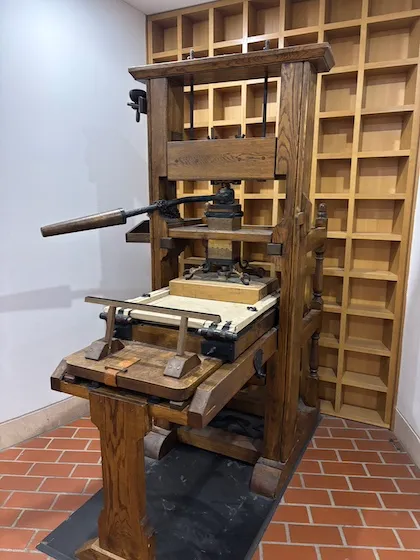
A printing press at the British Library
Curator: Bora Pajo
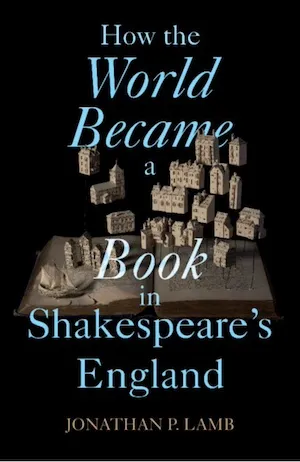
How the World Became a Book in Shakespeare's England
Jonathan P. Lamb How the World Became a Book in Shakespeare's England Cambridge University Press 336 pages, 6 x 9 inches ISBN 978-1009460415
Available here →September 22, 2025
20250922-lamb-jonathan-on-how-the-world-became-a-book-in-shakespeare-england-3
A close-up
The rest of this thread

Jonathan P. Lamb
Jonathan P. Lamb is Professor of English at the University of Kansas. He writes and teaches on Shakespeare, the history of the book, and early modern literature. He is author of many articles and two books (Shakespeare in the Marketplace of Words and How the World Became a Book in Shakespeare’s England), and he is currently working on a critical edition of Shakespeare’s comedy Love’s Labour’s Lost.
Pull this thread
Early modern England's dominant metaphors came from books rather than the theatre, and they composed thought, whiteness included.
Know something the rest of us don't?
Most threads on Rorotoko begin with our invitation. Any thread can begin with a proposal: you write it with the same prompts every thread answers, and we review it.
Propose a thread →