
Erin E. O'Connor
Fire Craft
The hot parts, of course! This includes two chapters, “Fire and Sweat” and “Materia Erotica". In "Fire and Sweat," I get my first taste, so to speak, of intracorporeality. I'm working on a team of glassblowers. It's my big break that's arranged for me by my instructor, Paul. Who says, "Girl, if you really want to learn glass, you got to work on a team.” The big day was on a hot and humid midsummer day, when it was nearly ninety degrees by 9AM. I "worked the doors" that day, meaning I opened and closed the doors of the glory hole, fired to about 2000 degrees Fahrenheit.
By the time I got home, I had white veins of salt crusting my clothes, skin, and hair. I had to peel off my clothes and, once showering, washed my hair and brushed my teeth multiple times. I could feel the salt crystals fall. It was an “Aha!” moment in which I saw the kinship of the glassy state and heat as viscerally shared and experienced among human bodies and a non-human medium. I call this intracorporeality. It differs from the intercorporeality, which assumes discrete bodies in collaboration. In "Materia Erotica,” I explore love in the hotshop.
The protagonist is Sarkis, a deft glassblower known in the hotshop as a "rock star”. We fall in love, become engaged, and then break off the engagement. Years later, Sarkis died from cancer at 45 years old. Years after his passing, I wrote the chapter. It’s an exploration of “making-love” and “making love" as orientations of becoming as production and as intracorporeality. I come to understand production as a heteronormative logic and intracorporeality as a queer orientation. I use the Greek concept of the pornê to unpack this. I came upon this concept in an analysis of Plato's Timaeus by classicist and architectural theorist Ann Bergren.
It indicates a woman who wanders between households, referring to a prostitute, but philosophically, Bergren connects the pornê to the unorganized and chaotic elements of a pre-Socratic cosmology. They formed a world, that is, without the so-called rule of law, namely a rational logic external to, and the organizing principle of, illogical matter. As an elemental ethnographer, I understand myself too as wandering, taking up queer residence with the salt and heat of intracorporeality instead of the straight logic of producing vessels, for example. To understand the pornê in terms of modern sexual prostitution would be to miss the point entirely.
I explicitly address the reader twice in the book. Once, on this occasion, given the importance of this point: “I invite you, dear reader, to feel the philosophical resonance of this tale from and with that chaotic and wandering participation of and with the anomalous elemental world. Intracorporeality unbound. Making ever-emergent will never be contained; the cup will always overflow. The pornê lets it do so. If empty, she puts it back on the shelf and perhaps sets the table with it that evening for company. It’ll be a lovely dinner party. Cups will break; cups will overflow.
The ways of love and strife are many, contained and uncontained.”Writing this chapter, I knew it was an homage that spoke to Sarkis. The day after I completed it, I fell into an inexplicable fever for a solid week.Fire Craft is one of a kind. There is no other ethnographic monograph of contemporary studio glassblowing. Biographies exist, but they don't have the view and experience of blowing glass from the inside-out. To be clear, my glassblowing skills are modest. But, I do know it and that sense makes a world of difference to the narrative. I write not about glassblowing but from glassblowing. This includes fellow glassblowers and our shared experiences and social world. I want Fire Craft to live as a historical record of everyday life in an American hotshop, interwoven as it is with its philosophical and socio-political significance. Legions of glassblowers have produced the ubiquitous glass objects of modernity, but have largely been forgotten in the dustbins of history.
This reflects the denigration of craft and manual labor broadly speaking in the West more than the meaning of their practice, which brings me to my second point. Making makes you a better thinker and thinking makes you a better maker. Fire Craft offers a persuasive case for vocational education. In Fire Craft, the reader learns about embodiment, the sensing extension of the human body into the world through objects, like a hammer in hand. Where do we feel the end of the hammer? At the nailhead that it strikes. My consideration of embodiment and the dynamics of apprenticeship reveals the role of the sensing human body in learning. Fire Craft is not nostalgic.
But, it does show that handwork matters. Through it, we learn to problem solve, collaborate with others, attend to materiality, and realize that we’re part of a world. Handwork contributes to the aesthetic, civic, intellectual, social, and environmental dimensions of human life. This is not at odds with the "Information Age". An example is the historical chapter of the book, The Glassy State, mentioned above. It was through my attention to the medium of the art - hot glass - and the furnace of its making that I began to see how studio glassblowing was interwoven with imperial and settler colonial glassmaking. Typically, sociology distinguishes work via the mode of production; the small team of craft glassmaking versus semi-mechanized early industrial glassmaking, for example. It was only through my wonder about glass that I saw how theories of the division of labor were woven from a Western ontology that has long separated man from nature, making him master of it.
This insight allowed me to retell the story of glassmaking at Jamestown in 1612 as one of American “plantation”. It’s such contributions that distinguish Fire Craft as seeding a field of critical glass studies.Publishing Fire Craft is a beginning rather than a conclusion. It has opened an entire inquiry into the medium and the mines and minerals of its making. This further decenters the human narrative, turning to what I'm calling a symgeology of studio account. I hope that Fire Craft gives back to the world of studio glass as much as studio glass continues to give me - fire for thought.
Curator: Bora Pajo
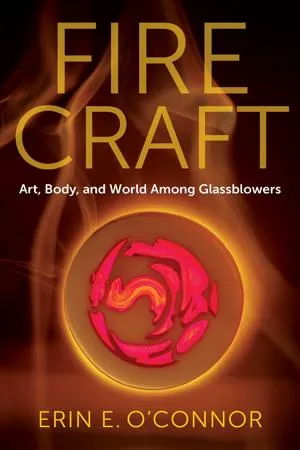
Fire Craft
Erin E. O'Connor Fire Craft: Art, Body, and World Among Glassblowers Columbia University Press 296 pages, 5 x 8 inches, ISBN 9780231218443
Available here →October 3, 2025
20251003-oconnor-erin-on-fire-craft-art-body-and-world-among-glassblowers-3
A close-up
The rest of this thread

Erin E. O'Connor
Dr. Erin E. O’Connor is an Associate Professor of Sociology at Marymount Manhattan College in New York City and the author of Fire Craft: Art, Body, and World among Glassblowers (Columbia University Press, 2025). She is renowned within the international community for her ground-breaking studies of glassblowing. As a recipient of the 2023 Rakow Grant for Glass Research, Dr. O’Connor launched her second book project, The Middle Mineral & the Mine: an Ethnogeology of Studio Glass. This research investigates the reciprocity of human creativity and geology in the material life of studio glass. Her research specializes in glass, the arts, culture, the body, knowledge, and the environment.
Pull this thread
Fire, heat and matter are participants in skill, which is never transmitted between humans alone.
Know something the rest of us don't?
Most threads on Rorotoko begin with our invitation. Any thread can begin with a proposal: you write it with the same prompts every thread answers, and we review it.
Propose a thread →