
David J. Helfand
The Universal Timekeepers
This book is about nothing. Or at least 99.999999999999% bits of nothingness. And yet it is about everything – all that you can touch, see, taste, smell, and feel, and you, and the room in which you are sitting, and this planet, our solar system, the Milky Way, and the entire visible Universe. All of it is composed of the bits of nearly completely empty space we call atoms.
You’ve never seen an atom because, besides being mostly empty space, they are very, very small: it takes 15 million trillion of them to make one poppy seed. If the atom were the size of a small marble, it would take a warehouse covering a full city block, twenty stories tall, to contain 1 trillion. Fifteen million trillion would be a warehouse covering all of New York State and extending upward to thirty stories. A lot of marbles. Despite their infinitesimal size and ephemeral nature, we have developed an intimate relationship with atoms. We can count them individually.
We can distinguish the 118 different types and the dozen or two flavors in which each type exists. We can transform them from one type to another and can query their interior states. Most importantly, we can take advantage of their imperturbable internal clocks to reconstruct the history of the Universe. This book provides an accessible introduction to atoms and describes how we can use them as unbiased historians. From the detection of art forgeries to the dating of archeological artifacts, from the history of agriculture and human diet to the complex story of Earth’s constantly changing climate, the little atomic historians are faithful guides. From the death of the dinosaurs 66 million years ago to the origin of life more than 3.5 billion years ago, atoms recount the story. The solar system’s birthday is determined precisely; the history of the Universe and all it contains, back to the first fraction of a second of its existence 13.8 billion years ago -- all is revealed in striking detail by atoms, the universal timekeepers.
Curator: Rachel Althof
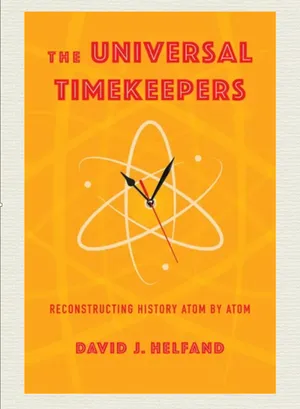
The Universal Timekeepers
David J. Helfand The Universal Timekeepers: Reconstructing History Atom by Atom Columbia University Press 288 pages, 6 x 9 inches, ISBN 9780231219037
Available here →October 13, 2025
20251013-david-helfand-universal-timekeepers
In a nutshell
The rest of this thread

William Thompson
David J. Helfand
David Helfand, a Columbia University faculty member for 48 years, served for two decades as Chair of the Astronomy Department. While he has mentored 22 PhD students, most of his pedagogical efforts have been aimed at teaching science to non-science majors including creating the course Frontiers of Science, now required for all first-year students. In 2005, he joined an effort to create Canada's first independent, non-profit university, Quest University, where he served as President & Vice-Chancellor from 2008-2015. He completed a four-year term as President of the American Astronomical Society and is currently Chair of the American Institute of Physics.
Pull this thread
Atoms decay at unalterable rates and carry no memory, so they are better historians than any human record.
Know something the rest of us don't?
Most threads on Rorotoko begin with our invitation. Any thread can begin with a proposal: you write it with the same prompts every thread answers, and we review it.
Propose a thread →