
Simon Ball
Death to Order
When he rides from one place to another, it is in an armored car, preceded and followed by armored cars filled with soldiers. He travels at a high rate of speed along a route guarded by rows of police. That could be a description of nearly any political leader today. It is, in fact, drawn from an account of the security arrangements for President Machado of Cuba in 1930, who Western commentators portrayed as dictatorial, cowed, and paranoid.
Like any good introduction, the introduction tells the reader about the book and its arguments. However, as an alternative, I’d direct the browser to the beginning of chapter 10, which reads: ‘For the West, the assassination world shifted most profoundly in the 1980s. Faced with an increasing number of assassination conspiracies, the western political elite changed its own status, way of living, and structural relationship with other citizens.’ Anyone interested in this idea should like the book.
I’d be very satisfied if Death to Order convinces writers, journalists, and readers to give up on counter-factual speculation about assassination. Assassinations have observable effects: our time is more fruitfully spent on those effects rather than fantastical non-happenings.
Curator: Bora Pajo
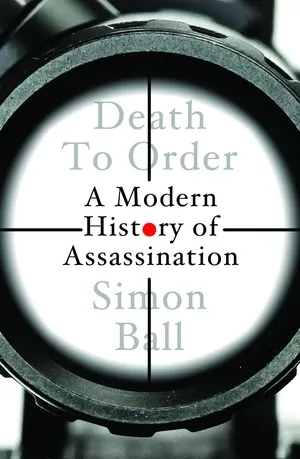
Death to Order
Simon Ball Death to Order: A Modern History of Assassination Yale University Press 464 pages, 6 x 9 inches, ISBN 9780300258042
Available here →October 16, 2025
20251016-ball-simon-on-death-to-order-history-of-assassination-3
A close-up
The rest of this thread

Simon Ball
Simon Ball has been the University’s Chair of International History & Politics at the University of Leeds since 2012. He previously served as Professor of Contemporary History at the University of Glasgow. As Academic Integrity Lead in the School of History, his research centers on the Cold War, the Second World War, British politics, assassination in international politics, and twentieth-century secret intelligence. Professor Ball edited War in History and sits on the editorial boards of Intelligence & National Security and Diplomacy & Statecraft. His books include Death To Order (2025), Secret History (2020), Alamein (2016; Folio Society 2022), The Bitter Sea (2009), The Guardsmen (2004), The Cold War (1998; reprinted 2009), and The Bomber in British Strategy (1995; Routledge 2022). He collaborates widely beyond academia, including authoring a 2022 REF Impact Case Study.
Pull this thread
Modern assassination is a state phenomenon, because the reaction of states is what gives political murder its charge.
Know something the rest of us don't?
Most threads on Rorotoko begin with our invitation. Any thread can begin with a proposal: you write it with the same prompts every thread answers, and we review it.
Propose a thread →