
Charles R. Butcher
Before Colonization
Page 6, which shows the difference between the number of states that are included in the data that underpin our book, compared to the number of states identified in existing data. The gap for the 19th century is very large, indicating the exclusion of hundreds of states from international relations research. Another favorite of mine would be page 166, which shows the states in West Africa and where they were located. It indicates how widespread and dense states were in this region before colonialism. Most quantitative studies of war, diplomacy, and trade that include the nineteenth century are trained on a small and skewed sample of only about a tenth of the states that actually existed. Yet the world was filled with hundreds of states in the early 1800s, most of them in Africa and Asia, but these states largely disappeared by the beginning of the twentieth century in what may be the largest state extinction event in history. (page 6)We hope that it raises awareness of how different the interstate system looked two hundred years ago and what a major event the coming of European colonialism was. Just seeing how many states there were across the globe in the nineteenth century is sometimes an eye-opening experience for people; it certainly was for us. We also hope that our work begins efforts to rectify the lack of attention that these regions have received in IR scholarship, and especially more quantitatively oriented scholarship. We have, for example, good data on all sorts of factors such as democracy, population, conflict, and the nature of state institutions for a small number of mostly European states, but they remain missing for most of the states that are in our book. It’s an exciting prospect to imagine how our understanding of some of the biggest questions in international relations – why do wars occur, why are some states more democratic than others, for example – might be changed if we had better information on these excluded states. Some of this work we have started with our most recent projects, but we hope also that others will begin this task. Finally, there is a burgeoning literature on the legacies of these states. Many did not simply disappear but were incorporated into colonial empires and sometimes colonial regimes governed by drawing on the state institutions provided by 19th century rulers. Moreover, these states often set in motion processes of identity change, and conflict, that research shows has important implications for conflict and institutions today.
Curator: Rachel Althof
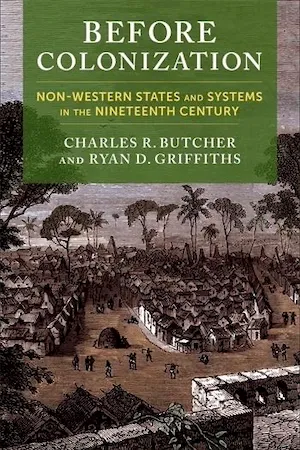
Before Colonization
Charles R. Butcher & Ryan D. Griffiths Before Colonization: Non-Western States and Systems in the Nineteenth Century Columbia University Press 344 pages 6 x 9 inches, ISBN 9780231219365
Available here →October 27, 2025
20251027-charles-butcher-before-colonization-nonwestern-states-and-systems-3
A close-up
The rest of this thread

Photograph by Kate Butcher
Charles R. Butcher
Charles is a Professor in the Department of Sociology and Political Science at the Norwegian University of Science and Technology. His research focuses on the legacies of historical states and state systems for institutions and dissent, along with unpacking the links between mass uprisings and institutional change. His work has been funded by the European, Norwegian, and Australian research councils and published in numerous international journals. He is the co-author (with Ryan Griffiths) of Before Colonization (2025), published by Columbia University Press.
Pull this thread
There were more sovereign states in 1825 than there are today.
Know something the rest of us don't?
Most threads on Rorotoko begin with our invitation. Any thread can begin with a proposal: you write it with the same prompts every thread answers, and we review it.
Propose a thread →