
Naofumi Nakamura
Trading Locomotives
In this book, I examined the history of Japan’s railroads, focusing on the locomotive trade and technological development from a global perspective. As railroads were a key industry of the Industrial Revolution, their worldwide proliferation proved integral to the emergence of a market-based global economy at the turn of the twentieth century. Japan’s railroads played an essential part in that story, and this book highlighted the international momentum that enabled the development of this industry by reconsidering the connections between the first global economy and the Industrial Revolution in Japan. In addition, I reevaluated the relationship between global and local events by examining how Japan, a relatively underdeveloped country during this time period, attempted to resist the forces of globalization through the localization of locomotive manufacturing. These processes also marked the beginning of Japan’s imperial expansion while advancing its national formation in response to globalization.
My book also examined the links between the nation-state and empire-building in terms of railroad development. The railroad—first introduced and developed as an essential tool for Japan’s nation-state building—was transformed into a tool for empire-building after the late 1890s. For locomotive manufacturers, it took Japan too long to acquire the technology required to build railroads throughout its empire. Thus, in the short term, Japan’s empire-building provided an expanded market for Western locomotive manufacturers. However, Japan succeeded in localizing and mass-producing large locomotives just before WWI and began transferring and exporting them to its colonies and spheres of influence. In this aspect, the government-led technology transfer and development promoted domestically educated engineers and rapidly grew Japan’s empire.
Curator: Rachel Althof
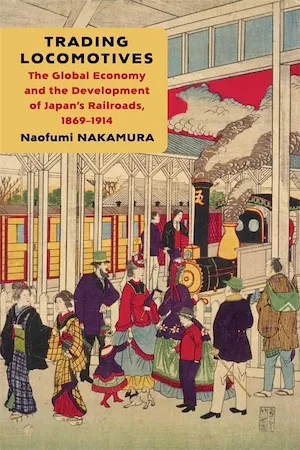
Trading Locomotives
Naofumi Nakamura Trading Locomotives: The Global Economy and the Development of Japan’s Railroads, 1869–1914 Columbia University Press 272 pages, ISBN: 9780231218467
Available here →November 10, 2025
20251110-nakamura-naofumi-on-trading-locomotives-1-1
In a nutshell
The rest of this thread

Naofumi Nakamura
Naofumi Nakamura is a professor at the Institute of Social Science at the University of Tokyo, Japan. He obtained his Ph.D. in History from Kyushu University and served as a visiting scholar of the Harvard-Yenching Institute from 2021 to 2022. Nakamura has written widely on the business and economic history of modern Japan, including railroad history, local history, and the history of technological transfer. His significant publications include Nihon Tetsudō-gyō no keisei [The Formation of Japan’s Railways] (1998), Chihō karano Sangyō-kakumei [Reconsidering Japan’s industrial revolution] (2010), and Nihon ni okeru Daikigyō no Kigen [The Origins of Big Business in Japan] (forthcoming).
Pull this thread
Japan's railways used competition among Western manufacturers to extract locomotive technology, obliging German firms to disclose their processes.
Know something the rest of us don't?
Most threads on Rorotoko begin with our invitation. Any thread can begin with a proposal: you write it with the same prompts every thread answers, and we review it.
Propose a thread →