
Naofumi Nakamura
Trading Locomotives
Let me share my personal perspective on my research journey. My interest began with the fascinating question of Japan's industrialization. How did Japan, a small island nation viewed by the West as a distant frontier, embark on rapid industrialization after the Meiji Restoration and quickly catch up with Western powers? I believed that to understand this phenomenon, it was essential to explore the mechanisms of the Industrial Revolution, which serve as the foundation for industrialization. This led me to focus my research on Japan's own Industrial Revolution.
Initially, my attention was directed toward the railroad industry, which was one of the key sectors in Japan's Industrial Revolution. A significant aspect of railroad development in Japan was the strong support it received from local communities, which played a crucial role in establishing many railroad companies. However, starting a railroad company demanded considerable capital, diverse technical expertise, and skilled management. This raised the question: how did these local communities manage to secure the necessary managerial resources? To find answers, I investigated the local economies during the era of the Industrial Revolution. My research uncovered a financial foundation and human networks that supported local industrialization. However, it remained unclear how the essential materials and engineers for railroad construction and operation were procured. Consequently, I shifted my focus to understanding why railroad materials and engineers, crucial for its construction and operation, were smoothly supplied to Japan, despite its location in the Far East. This forms the core research question of this book.
In this book, I examined material procurement in Japanese railroad companies from various perspectives, focusing on its connection to the global economy during the transition between the 19th and 20th centuries. This discussion ties into debates in international business history, particularly regarding the role of Japanese trading companies and the beginnings of global marketing by American manufacturing firms. This book also explores the autonomy of Japanese engineers and their original technological advancements in locomotive manufacturing, providing a crucial case study in the history of technology. Additionally, one of the research perspectives introduced in this book—examining the interplay between globalization and localization in the context of locomotives—is expected to present new arguments within the global history of mechanical products. Furthermore, another significant context of this book is the exploration of the relationship between nation-state building and empire building, particularly regarding Japan's railroad development. This topic is a central theme in modern Japanese history.
Curator: Rachel Althof
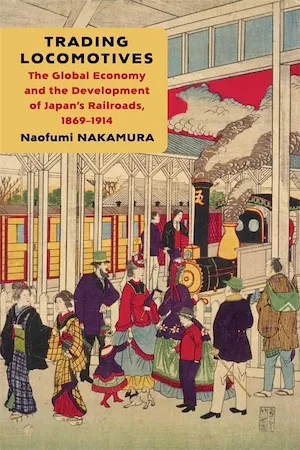
Trading Locomotives
Naofumi Nakamura Trading Locomotives: The Global Economy and the Development of Japan’s Railroads, 1869–1914 Columbia University Press 272 pages, ISBN: 9780231218467
Available here →November 10, 2025
20251110-nakamura-naofumi-on-trading-locomotives-2
The wide angle
The rest of this thread

Naofumi Nakamura
Naofumi Nakamura is a professor at the Institute of Social Science at the University of Tokyo, Japan. He obtained his Ph.D. in History from Kyushu University and served as a visiting scholar of the Harvard-Yenching Institute from 2021 to 2022. Nakamura has written widely on the business and economic history of modern Japan, including railroad history, local history, and the history of technological transfer. His significant publications include Nihon Tetsudō-gyō no keisei [The Formation of Japan’s Railways] (1998), Chihō karano Sangyō-kakumei [Reconsidering Japan’s industrial revolution] (2010), and Nihon ni okeru Daikigyō no Kigen [The Origins of Big Business in Japan] (forthcoming).
Pull this thread
Japan's railways used competition among Western manufacturers to extract locomotive technology, obliging German firms to disclose their processes.
Know something the rest of us don't?
Most threads on Rorotoko begin with our invitation. Any thread can begin with a proposal: you write it with the same prompts every thread answers, and we review it.
Propose a thread →