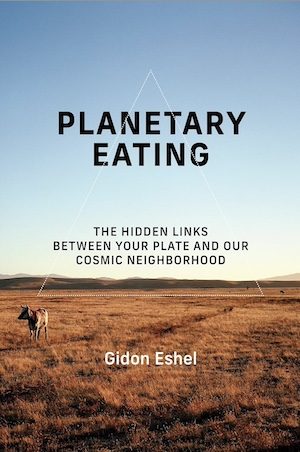
The book’s essence: only facts. My work on the geophysics of food “…has thrust me into an intense multidimensional public debate. One aspect involves the tension between idealistic, small-scale, “local” agriculture on the one hand, and the currently dominant massively intensive corporate mega-farms on the other. Another very dominant debate centers on beef as either the source of or the cure to all agricultural ills. In keeping with this polarity, my popular writing and media interviews typically receive online comments from individuals that are roughly evenly split between blindingly enlightened, zero-doubt vegan activists, and angry self-appointed beef and big ag defenders. And when I publish papers that suggest that in some circumstances beef may play productive roles, the comments endure, but the camps neatly reverse, like Prussian troops in formation. Such incuriosity rarely begets serious fact- and logic-based inquiry, yet it is sadly common in the public discourse on food, agriculture, and diet. The only standard I have used is a strict adherence to the guiding science—sometimes foundational, sometimes applied—and to veritable, robust observations. I am guided by the (possibly naive) notion that if you just highlight sufficiently clearly, in widely understood language, the foundational, logical, or factual holes in some of the commonly held views, people will listen.”Food as our primary connector to our solar system neighborhood. “… Some would associate the beginning of the story with the green revolution, the industrial revolution, colonialism, the European pillaging of the Americas, or the dawn of agriculture in the Fertile Crescent. While clearly important, these are merely recent chapters in a story whose prologue unfolded over 4.5 billion years ago, as our solar system coalesced from clouds of interstellar dust, or earlier still, when that dust acquired its material attributes from earlier generations of long-gone stars. Fundamentally, agriculture builds directly on these processes, which—through nuclear interactions that involve protons and neutrons in atomic nuclei—create the tangible materials around us, and determine their chemical properties. In turn, these shape agriculture, which is nothing but controlled fluxes of energy and mass between various interconnected Earth’s components. If this seems odd, think about work-performing muscles; are they not fueled by the calories in our food, which are stored solar energy, liberated by nuclear fusion in our star, the sun? Or think of irrigation, the redistribution of water whose mass is about 90% oxygen. Is the oxygen nucleus not four helium nuclei, fused together in stellar interiors?”On my non-traditional upbringing. “I grew up on the ocean, the son of a ship captain. For most of my childhood, my older sister Tami was the only fellow child I knew, and we shared a diminutive cabin with our parents on an old, small ship. For Tami and me, schooling, such as it was, constituted an unusually lax one-woman Department of Education our mother ran, intermittently, on board. With months at sea at a stretch, and neither formal education nor any structured commitments to avert suffocating boredom, we became consummate self-educators. The natural world I witnessed from the ship was what truly captivated me. Nature grabbed hold of me and never let go. What turned the lazy green-brown waters of the sheltered Elbe River, I wondered, into a gray tempest upon departing Antwerp into the North Sea? Why did the still Malmo fog give way to glassy ice as we crossed the Baltic Sea southward, toward the Kiel canal and ultimately Hamburg? Why are the eastern Adriatic waters gin-clear, while approaching Venice, just 100 miles away, is like floating on coffee?Decades later, working with two titans of modern fluid physics, Mark Cane at Columbia and Brian Farrell at Harvard, all these maritime experiences gradually cohered into a unified story, finally allowing me to turn basic observations of the natural world into a crisp scientific construct.”On rebellion cuisine (following a salad recipe). “Not merely delightful, our salad is a political statement that, like lunch counter sit-ins, sends a clear message that we hereby resign our assigned role in the farce, because it sickens us, in more ways than one.To be adapted widely enough for success, rebellion cuisine must be—like our salad—delicious, affordable, healthy. We do not need chefs’ environmental musings because they tend to be too scientifically naïve to be useful, and the price tags of the food they promote are laughable. Instead, we need good, honest cooks who develop and perfect affordable, healthy recipes that are poised to become highly popular. While experience shows it can be done, it often isn’t. Such food has been ubiquitous and cheap in any Middle Eastern town, continuously and unfailingly, through droughts and deluges, since well before Jesus was born there. Are the people of the US, France, or Germany so fundamentally less discerning than the denizens of these bygone towns?!Which brings us to the final pillar of rebellion cuisine, health. This salad and similar meals will, statistically speaking, extend your life and reduce disease during those longer years. As this book has shown in excruciating detail, all the health-related notions invoked to promote the necessity of animal products are houses of empirical cards.If you, like countless others, are disillusioned with our food system, here is a delicious, practical alternative to its compromised output. Not only is our salad tastier and nutritionally and environmentally far superior, it puts agribusinesses on notice that continuing to promote disease and environmental degradation requires finding a new population to undermine, because we choose life over agribusiness's bottom line, health over elective degenerative disease, and actual planetary betterment over the vacuous environmental platitudes these businesses typically promulgate.”I wrote Planetary Eating with the hope that it would replace unfounded, unscientific thinking and gratuitous assertions in the conversation on the confluence of food, agriculture, the environment, and public health. I was also hoping it would disabuse readers of the false notion that one can discuss knowledgably and learnedly these confluences while disregarding or paying scant attention to planetary science. As I see it, agriculture is planetary science by another name; how can you hope to speak cogently of agriculture, therefore, while choosing to remain minimally educated at best about planetary science?!