
Valerie Steele
Dress, Dreams, and Desire
I first read Interpretation of Dreams when I was about 14 or 15, and I left school when I was 15, and lived in a commune. I never finished high school, but I eventually went to college. And then, in graduate school, I went to Yale to get my PhD in Modern European Cultural and Intellectual History. I had an epiphany when I realized fashion is part of culture, and I can do fashion history. Which made me essentially unemployable for more than a decade, because no history department would hire someone working on such a fluffy, frivolous subject. But this intrigued me that fashion was seen as being so superficial.
It became clear to me early on that this was in large part because fashion is literally superficial. It's on the surface of your body, and because of mind-body dualism, the body was often denigrated, particularly when it was a female body. So, it seemed to me that in reality, fashion is significant and important precisely because of its intimate connection with the physical body, which is so closely related to the development of the sense of self. That your psychic sense of yourself is as an embodied self. We are embodied.
One of my professors at Yale was Peter Gay, who was Freud's biographer. Even when he was my professor, he was studying psychoanalysis and writing books like Freud, Jews and Other Germans and Freud for Historians. So, I was familiar with Freud, but not so much with later psychoanalysts. I used psychoanalytic thought in my doctoral dissertation about the erotic aspects of fashion, because if you're talking about eroticism, you have to pay attention to psychoanalysis.
Later, when I did exhibitions and books such as The Corset, or Fetish: Fashion, Sex & Power or Gothic: Dark Glamour, psychoanalysis would pop in occasionally. But when I did A Queer History of Fashion, I hardly mentioned it because Freud was so clearly the enemy as far as most LGBTQ people and feminists were concerned.
In 2012, the fashion journalist Susie Menkes did a whole profile of me, which she titled The Freud of Fashion. I was flattered, of course, but also a little nervous and embarrassed because people didn't think much of Freud in 2012. A couple of years later, in 2015, I was invited to speak about Freud and fashion at a conference that the London College of Fashion organized in conjunction with the Freud Museum in London.
And I gave a little talk about Freud's ideas and some of Flügel's ideas. While at that conference, I met several psychoanalysts who were Lacanian psychoanalysts. And so I thought maybe I should look into that. Reading Lacan is like fighting your way through a jungle with no machete, just a dull butter knife. It's very hard to understand what he's saying, and I would write to Anoushka Grose, and say, “what does he mean by this?” After that I started thinking about a show about fashion and psychoanalysis.
I read other contemporary analysts, and pieced together, laboriously, what different people thought, and gradually built these into a more or less coherent book. I didn't want to just write the introduction to a book. I wanted to see if I could actually do a cultural history of fashion and psychoanalysis. So it took more than 5 years—a hell of a lot longer than most exhibitions and books.
%2520(1).webp)
© The Museum at the Fashion Institute of Technology
.webp)
© The Museum at the Fashion Institute of Technology
%2520(1).webp)
© The Museum at the Fashion Institute of Technology
%2520(1).webp)
© The Museum at the Fashion Institute of Technology
Curator: Bora Pajo

Dress, Dreams, and Desire
Valerie Steele Dress, Dreams, and Desire: A History of Fashion and Psychoanalysis, Bloomsbury, 264 pages, 7.5 x 9.7 inches, ISBN:9781350428195
Available here →December 20, 2025
20251206-steele-valerie-dress-dreams-desire-history-fashion-psychoanalysis-2
The wide angle
The rest of this thread
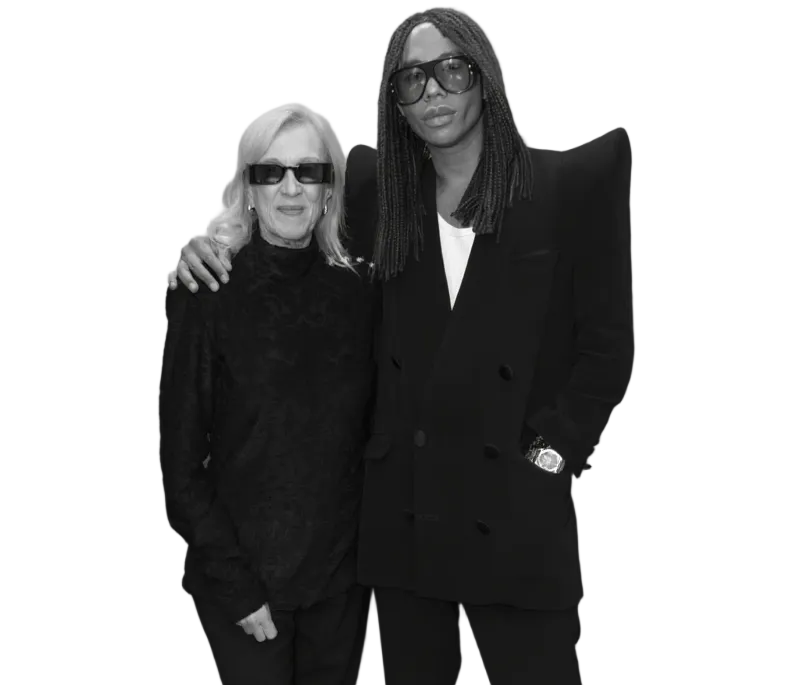
With Olivier Rousteing. © The Museum at the Fashion Institute of Technology
Valerie Steele
Valerie Steele is director and chief curator of The Museum at the Fashion Institute of Technology, where she has organized more than 25 exhibitions since 1997, including The Corset: Fashioning the Body, London Fashion, Gothic: Dark Glamour; A Queer History of Fashion: From the Closet to the Catwalk, Pink: The History of a Punk, Pretty, Powerful Color and Paris, Capital of Fashion, Dress, Dreams, and Desire: Fashion and Psychoanalysis. She is also the author or editor of more than 30 books, including Paris Fashion, Women of Fashion, Fetish: Fashion, Sex and Power, The Corset, The Berg Companion to Fashion, and. Fashion Designers A-Z: The Collection of The Museum at FIT. Her books have been translated into Chinese, French, German, Italian, Portuguese, Russian, and Spanish. In addition, she is founder and editor in chief of Fashion Theory: The Journal of Dress, Body & Culture, the first scholarly journal in Fashion Studies. Steele combines serious scholarship (and a Yale Ph.D.) with the rare ability to communicate with general audiences. As author, curator, editor, and public intellectual, Valerie Steele has been instrumental in creating the modern field of fashion studies and in raising awareness of the cultural significance of fashion. She has appeared on many television programs, including The Oprah Winfrey Show and Undressed: The Story of Fashion. Described in The Washington Post as one of “fashion’s brainiest women” and by Suzy Menkes as “The Freud of Fashion,” she was listed as one of “The People Shaping the Global Fashion Industry” in the Business of Fashion 500: (2014 to the present).
Pull this thread
Fashion is significant precisely because it is superficial, and psychoanalytic concepts are the right instruments for reading clothes.
Know something the rest of us don't?
Most threads on Rorotoko begin with our invitation. Any thread can begin with a proposal: you write it with the same prompts every thread answers, and we review it.
Propose a thread →