
Stefan Kölsch
Good Vibrations
Good Vibrations is a book about the healing power of music: how it affects our brains, our emotions, and ultimately our health. Most people have heard that music can be good for us. What I wanted to do in this book is to show why this is true, and how it works.
Drawing on neuroscience, psychology, and everyday experience, I explore how music activates biological and emotional systems that are deeply linked to wellbeing. When we listen to or make music, almost the entire brain becomes active: areas involved in emotion, movement, memory, language, and even the immune and hormonal systems. These activations are not random, but they are the reason why music can calm us, energise us, and sometimes even heal us.
The book combines scientific explanation with real stories, showing what happens when music is used in therapy, in hospitals, or simply in daily life. It explains, for example, how music can reduce stress by regulating the body’s autonomic nervous system, namely the system that controls heartbeat, breathing, and digestion. It shows how music strengthens social bonds, promotes empathy, and releases neurochemicals such as dopamine and endorphines that support pleasure, trust, and connection. And it also describes how the wrong kind of music, or music in the wrong context, can have the opposite effect, reinforcing sadness, anxiety, or aggression.
At a deeper level, Good Vibrations is also about what it means to be human. Music connects us to one another and to ourselves. It has evolved with us as a biological and social force: a language of emotion that predates words, and one that still reaches where words cannot.
I wrote the book so that readers can not only understand the science, but also use it. Each chapter contains practical insights and simple exercises that can help readers apply music to reduce stress, improve mood, and nurture emotional balance.
I hope readers will not just read this book with their eyes, but listen with their whole being, to discover that music is not simply decoration for our lives, but one of the most powerful medicines we already possess.
Curator: Rachel Althof
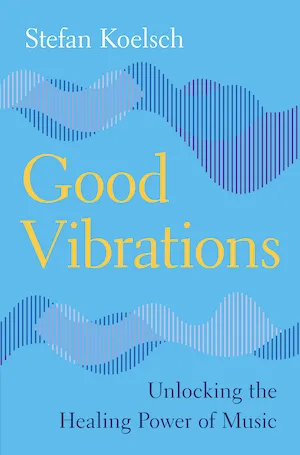
Good Vibrations
Stefan Kölsch (2025). Good Vibrations: Unlocking the Healing Power of Music Cambridge University Press 346 pages, 6.25 x 1 x 9.25 inches ISBN 978-1009366779
Available here →December 27, 2025
20251227-koelsch-stefan-on-good-vibrations-2
In a nutshell
The rest of this thread

Stefan Kölsch
Stefan Kölsch is a German–American–Norwegian neuroscientist, psychologist, violinist, and bestselling author whose work explores how music shapes the brain, emotions, and health. He studied music, psychology, and sociology in Germany, completed his PhD at the Max Planck Institute for Human Cognitive and Brain Sciences, and held positions at Harvard Medical School, the University of Sussex, and the Free University of Berlin. He is now Professor of Biological and Medical Psychology and Music Psychology at the University of Bergen, Norway.Kölsch is internationally recognised for pioneering research on the neural foundations of music and emotion. His studies revealed that music activates the same brain systems involved in emotion, reward, and social bonding, findings that have transformed our understanding of how music can promote mental and physical wellbeing.Bridging science, art, and human experience, Kölsch’s work aims to make complex research accessible to everyone. In Good Vibrations, he shows how melodies and rhythms can heal, connect, and inspire us, offering practical insights for musicians, therapists, healthcare professionals, and anyone who wants to use music to live a healthier and more fulfilling life.
Pull this thread
Music is a biological force that does what no single drug can, and medicine massively underuses it.
Know something the rest of us don't?
Most threads on Rorotoko begin with our invitation. Any thread can begin with a proposal: you write it with the same prompts every thread answers, and we review it.
Propose a thread →